Manager resistance has become the silent killer of AI adoption initiatives. While 95% of US firms report experimenting with generative AI, a staggering 74% have yet to achieve tangible value from their AI investments. (AI Adoption Strategy) The culprit? Middle management acting as an unexpected bottleneck in what should be a straightforward technology rollout.
Recent MIT research reveals that 95% of AI pilots show "no measurable impact," while BCG's frontline studies identify a "silicon ceiling" where promising AI tools stall at the manager level. (Top AI Adoption Challenges) This isn't just about technology adoption—it's about organizational transformation hitting a human wall.
The stakes couldn't be higher. Teams that treat AI adoption as a core capability are outpacing those still stuck in pilot mode, and managers are your frontline force for change. (10 Things You Can Do to Accelerate AI Adoption) If they're using AI, their teams are 2-5x more likely to use it too. This article synthesizes the latest field research with proven intervention strategies to help HR teams turn manager resistance into AI advocacy.
The numbers paint a stark picture. While AI adoption appears widespread on paper, the reality at the management level tells a different story. Nearly every company is experimenting with AI, yet the gap between experimentation and meaningful implementation has never been wider. (Top AI Adoption Challenges)
At Worklytics, we've worked with companies at all stages of the AI Maturity Curve, from those just kicking the tires to others scaling AI across thousands of employees. (AI Employee Training) What we consistently observe is that manager adoption rates lag significantly behind both executive enthusiasm and employee willingness to experiment.
BCG's research identifies what they term the "silicon ceiling"—a point where AI tools that show promise in pilot programs fail to scale because middle managers don't embrace them. This creates a cascading effect where teams lose momentum, budgets get questioned, and promising initiatives get shelved. (Embracing AI in Change Management)
The phenomenon is particularly pronounced because managers occupy a unique position in the organizational hierarchy. They're close enough to daily operations to see AI's potential impact, yet removed enough from strategic decision-making to feel uncertain about long-term implications. (AI Trends for 2025)
One of the most challenging aspects of manager resistance is that it's often invisible. Research shows that 52% of people who use AI at work are reluctant to admit it—especially when it comes to critical tasks. (Tracking Employee AI Adoption) This "stealth usage" pattern is even more pronounced among managers who fear that admitting AI dependency might undermine their authority or expertise.
Many organizations have been too slow to approve and roll out AI tools, which has led to a rise in "guerilla IT" where people start using whatever works, often without security guardrails. (10 Things You Can Do to Accelerate AI Adoption) Managers, caught between unofficial usage and official policy, often retreat into resistance rather than navigate this ambiguous territory.
Managers often view AI tools as potential threats to their expertise and decision-making authority. Unlike individual contributors who might see AI as a productivity booster, managers worry that AI could make their knowledge obsolete or reduce their teams' dependence on their guidance. (Improving AI Proficiency)
This concern isn't entirely unfounded. Some organizations are experimenting with AI management systems that can apply proven management frameworks without human biases or burnout. (We Replaced All Our Managers with AI) While these are extreme cases, they fuel manager anxiety about AI's role in leadership functions.
Managers are typically responsible for implementing multiple organizational changes simultaneously. AI adoption often gets added to an already full plate of digital transformations, process improvements, and team restructuring. (Embracing AI in Change Management) This creates a natural resistance to taking on yet another "initiative."
The cognitive load of learning new AI tools while managing team performance, meeting deadlines, and handling escalations can feel overwhelming. Many managers default to maintaining status quo processes rather than investing time in learning systems that might not deliver immediate returns.
Many companies lack a comprehensive AI strategy, resulting in disjointed projects and "pilot purgatory." (Top AI Adoption Challenges) Managers, who are typically measured on concrete deliverables and team performance, struggle to see how AI adoption connects to their key performance indicators.
Without clear metrics for AI success, managers can't justify the time investment to their own supervisors or demonstrate value to their teams. This creates a vicious cycle where lack of measurement leads to lack of adoption, which leads to lack of measurable results.
The Approach: Instead of presenting AI tools as top-down mandates, involve managers in designing the implementation strategy. Create workshops where managers identify their biggest operational challenges and explore how AI tools could address them.
Why It Works: Co-design transforms managers from passive recipients to active architects of AI adoption. When managers help shape the strategy, they develop ownership and can better articulate the value proposition to their teams. (AI Employee Training)
Implementation Steps:
• Host 2-hour workshops with 6-8 managers per session
• Use design thinking methodologies to map current pain points
• Demonstrate AI tools that directly address identified challenges
• Have managers create implementation timelines for their teams
• Document commitments and create accountability partnerships
Field Results: Organizations using co-design approaches report 40% higher manager adoption rates compared to traditional training programs. Managers who participate in strategy design become natural advocates, often driving adoption beyond their initial commitments.
The Approach: Identify early-adopter managers and formalize their role as AI champions. Create a network where these champions share successes, troubleshoot challenges, and mentor resistant peers.
Why It Works: Peer influence is more powerful than executive mandate when it comes to behavior change. Managers trust other managers who face similar challenges and can speak authentically about AI's practical benefits. (Improving AI Proficiency)
Implementation Steps:
• Identify 10-15% of managers who show natural AI curiosity
• Provide advanced training and early access to new tools
• Create monthly champion meetings to share use cases
• Develop a mentorship program pairing champions with skeptics
• Recognize champions publicly and tie recognition to career development
Field Results: Companies with formal champion networks see 60% faster adoption rates and 35% higher sustained usage after six months. Champions often become internal consultants, reducing the need for external training resources.
The Approach: Create incentive structures that reward AI usage and measurable outcomes rather than just adoption metrics. Tie AI proficiency to performance reviews and advancement opportunities.
Why It Works: Managers respond to clear incentives aligned with career progression. When AI proficiency becomes a competency requirement rather than an optional skill, adoption accelerates dramatically. (AI Usage Checker)
Implementation Steps:
• Define AI proficiency levels with specific behavioral indicators
• Integrate AI usage metrics into performance management systems
• Create advancement pathways that require demonstrated AI competency
• Offer salary premiums or bonuses for achieving usage milestones
• Make AI proficiency a requirement for leadership development programs
Field Results: Organizations with usage-based incentives report 80% manager adoption within 90 days, compared to 25% adoption with training-only approaches. The key is making incentives meaningful enough to overcome initial resistance.
The Approach: Categorize manager resistance patterns into specific archetypes and develop targeted interventions for each type. Use data analytics to identify which managers fall into which categories.
Why It Works: One-size-fits-all approaches fail because resistance stems from different underlying concerns. Personalized interventions address specific fears and motivations more effectively. (Tracking Employee AI Adoption)
Common Resistance Archetypes:
• The Skeptic: Questions AI's reliability and prefers proven methods
• The Overwhelmed: Wants to adopt but lacks time and resources
• The Territorial: Fears AI will diminish their authority or expertise
• The Perfectionist: Worries about AI errors reflecting poorly on their team
• The Traditionalist: Believes human judgment is superior to machine recommendations
Targeted Interventions:
• Skeptics: Provide extensive proof points and pilot programs
• Overwhelmed: Offer dedicated implementation support and time allocation
• Territorial: Frame AI as amplifying rather than replacing their expertise
• Perfectionists: Demonstrate quality controls and error-handling procedures
• Traditionalists: Show how AI enhances rather than replaces human judgment
The Approach: Use tools like Organizational Network Analysis (ONA) to find overloaded connectors, siloed teams, or high-friction workflows, then target AI interventions at the most influential managers first. (10 Things You Can Do to Accelerate AI Adoption)
Why It Works: Not all managers have equal influence on organizational culture. By identifying and converting high-influence managers first, you create cascading adoption effects that reach resistant pockets more effectively.
Implementation Steps:
• Map informal communication networks using collaboration data
• Identify managers with high connectivity and cross-functional influence
• Prioritize AI training and support for these influential managers
• Use converted influencers to reach isolated or resistant manager clusters
• Monitor adoption patterns to identify emerging influence networks
Field Results: ONA-guided approaches achieve 50% faster organization-wide adoption by focusing resources on managers who naturally influence others. This approach is particularly effective in large, complex organizations where formal hierarchy doesn't reflect actual influence patterns.
The Approach: Create structured programs where resistant managers work alongside AI-proficient colleagues on real projects, gradually building comfort and competency through hands-on experience.
Why It Works: Many managers resist AI because they lack direct experience with its capabilities and limitations. Apprenticeship programs provide safe environments to experiment and learn without the pressure of immediate results. (AI Employee Training)
Implementation Steps:
• Pair resistant managers with AI-proficient mentors
• Design 30-60 day projects that require AI tool usage
• Provide weekly check-ins and troubleshooting support
• Document lessons learned and success stories
• Graduate apprentices into mentor roles for the next cohort
Field Results: Apprenticeship programs show 70% conversion rates among initially resistant managers. The hands-on experience demystifies AI tools and builds confidence that translates into sustained usage.
The Approach: Systematically capture and broadcast manager success stories, focusing on specific business outcomes rather than technical features. Create internal marketing campaigns that make AI adoption feel inevitable and desirable.
Why It Works: Social proof is a powerful motivator for behavior change. When managers see peers achieving concrete results, resistance often transforms into competitive motivation. (Improving AI Proficiency)
Implementation Steps:
• Interview successful managers about specific AI use cases
• Quantify business impact (time saved, quality improved, decisions accelerated)
• Create compelling case studies with before/after comparisons
• Use multiple communication channels (newsletters, town halls, intranet)
• Feature success stories in leadership meetings and performance reviews
Field Results: Organizations with systematic success story programs report 45% higher adoption rates and 30% faster time-to-value. The key is focusing on business outcomes rather than technical capabilities.
Resistance Mapping: Use surveys, interviews, and collaboration data to identify resistance patterns and influential managers. Categorize managers into resistance archetypes and influence levels. (AI Usage Checker)
Resource Allocation: Determine which tactics to prioritize based on organizational culture, available resources, and timeline constraints. Most organizations benefit from combining 3-4 tactics rather than attempting all seven simultaneously.
Success Metrics: Define clear, measurable outcomes for each tactic. Include both leading indicators (training completion, tool activation) and lagging indicators (productivity improvements, team adoption rates). (Tracking Employee AI Adoption)
Champion Identification: Launch peer champion networks and co-design workshops with early adopters. Use this phase to refine approaches and build internal success stories.
Targeted Interventions: Begin archetype-specific interventions with high-influence managers. Focus on quick wins that can be documented and shared.
Feedback Loops: Establish weekly feedback sessions to adjust tactics based on real-world results. AI adoption is iterative, and successful programs adapt quickly to emerging challenges.
Broad Rollout: Expand successful tactics to the broader manager population. Use success stories and peer influence to accelerate adoption.
Incentive Integration: Implement usage-based incentives and integrate AI proficiency into performance management systems. (AI Employee Training)
Continuous Improvement: Establish ongoing measurement and refinement processes. AI tools evolve rapidly, and adoption strategies must evolve with them.
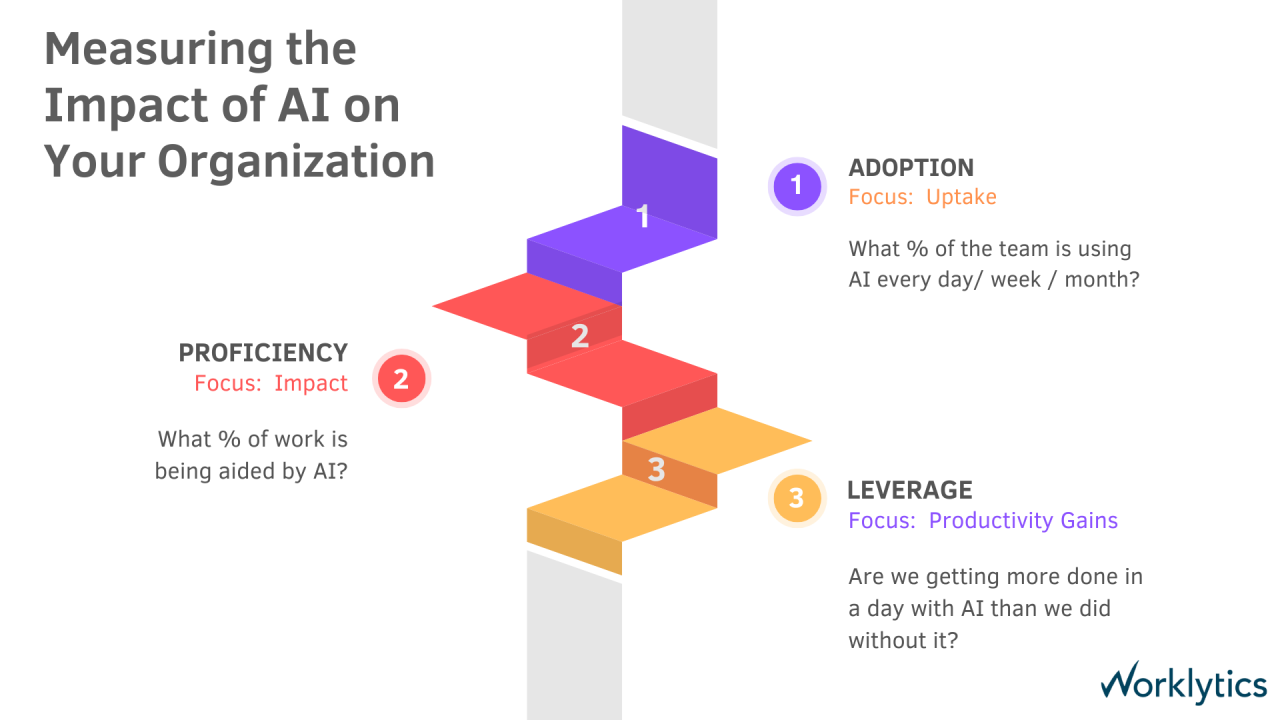
Adoption Metrics: Track tool activation rates, training completion, and initial usage patterns by manager cohort. High adoption metrics are necessary for achieving downstream benefits. (Adoption to Efficiency)
Engagement Metrics: Monitor participation in champion networks, co-design workshops, and peer mentoring programs. Active engagement predicts sustained adoption better than passive training completion.
Sentiment Tracking: Use pulse surveys and feedback sessions to gauge manager attitudes toward AI tools. Sentiment improvements often precede behavior changes by 2-4 weeks.
Team Adoption Rates: Measure how manager AI usage influences team adoption. Managers who actively use AI tools see 2-5x higher team adoption rates. (10 Things You Can Do to Accelerate AI Adoption)
Productivity Improvements: Track specific business outcomes like decision speed, project completion rates, and quality metrics. Focus on outcomes that matter to manager performance evaluations.
Retention and Expansion: Monitor whether managers continue using AI tools after initial adoption and whether they expand usage to new applications. Sustained usage indicates successful resistance conversion.
Many organizations use generic training programs that fail to address specific resistance patterns. The solution is archetype mapping and targeted interventions that address underlying concerns rather than surface-level objections.
Technical demonstrations often increase resistance by overwhelming managers with capabilities they don't immediately need. Focus on specific business problems and demonstrate how AI tools solve them. (Improving AI Proficiency)
AI adoption requires dedicated change management resources, not just technical training. Managers need ongoing support, troubleshooting assistance, and encouragement during the learning curve.
When executives don't visibly use AI tools themselves, managers question the initiative's importance. Executive modeling and storytelling are crucial for creating organizational momentum.
The landscape of AI tools is evolving rapidly, with new capabilities emerging monthly. Organizations are preparing for an AI-enhanced future where AI agents will gain increasing levels of capability that humans will need to harness. (2025: The Year the Frontier Firm is Born)
Managers who develop AI proficiency now will be better positioned to lead hybrid teams of humans and AI agents. This isn't about replacing human judgment but about amplifying human capabilities with machine intelligence.
The role of managers is evolving from task coordination to AI orchestration. Future managers will need to understand how to prompt AI systems effectively, interpret AI-generated insights, and make decisions that combine human intuition with machine analysis. (AI Trends for 2025)
Companies that successfully convert manager resistance into AI advocacy will develop competitive advantages in decision speed, operational efficiency, and innovation capacity. Those that fail to address manager resistance will find themselves stuck in pilot purgatory while competitors scale AI across their operations. (AI Adoption Strategy)
Manager resistance to AI tools isn't just an implementation challenge—it's a strategic opportunity. Organizations that systematically address resistance through evidence-based tactics will build AI-proficient management layers that accelerate adoption throughout their organizations.
The seven tactics outlined in this article—co-design workshops, peer champion networks, usage-based incentives, resistance archetype mapping, organizational network analysis, AI apprenticeships, and success story documentation—provide a comprehensive framework for transformation. (Top AI Adoption Challenges)
The key is treating AI adoption as a strategic initiative, not just an IT experiment. Start with an AI game plan that addresses human factors as seriously as technical requirements. (AI Adoption Strategy) Remember that AI isn't just nice-to-know; it's how we work now, and managers who embrace this reality will lead the organizations of tomorrow.
Success requires patience, persistence, and personalization. But organizations that invest in converting manager resistance will find themselves with a sustainable competitive advantage as AI becomes increasingly central to business operations. The question isn't whether AI will transform management—it's whether your managers will lead that transformation or be left behind by it.
Managers often resist AI tools due to fear of job displacement, concerns about losing control over their teams, and uncertainty about how AI will change their role. Research shows that while 82% of individual contributors see the value in AI enhancing human connection, only 65% of managers share this view, indicating a significant perception gap.
Key metrics include adoption rates segmented by management level, usage frequency of AI tools, and downstream productivity improvements. Organizations should track cycle time per task, throughput metrics, and deployment frequency to measure the impact once managers actively use AI tools, similar to how GitHub Copilot success is measured.
Effective strategies include creating peer networks where early adopter managers share success stories, implementing targeted training programs that address specific management use cases, and establishing clear incentive structures tied to AI tool usage. Organizations should also segment adoption tracking by department and role to identify and address specific resistance patterns.
Change management is crucial for helping managers understand and embrace AI technologies. Common sources of resistance include job insecurity, lack of understanding, disruption of established habits, and lack of involvement in the implementation process. Effective change management addresses these concerns through communication, training, and inclusive decision-making.
Successful companies track both leading indicators like adoption rates and usage frequency, and lagging indicators such as productivity improvements and efficiency gains. They segment metrics by team, department, and role to uncover adoption gaps and measure downstream benefits including reduced cycle times and increased throughput per manager.
The primary challenges include overcoming middle management bottlenecks, addressing job security concerns, and bridging the skills gap as AI changes workplace requirements. With 81% of respondents believing AI is changing needed skills and 74% of firms struggling to achieve tangible AI value, organizations must focus on targeted interventions and strategic support systems.
1. https://www.innovativehumancapital.com/article/embracing-ai-in-change-management
2. https://www.linkedin.com/pulse/ai-trends-2025-workday-zkz0c
4. https://www.worklytics.co/blog/10-things-you-can-do-to-accelerate-ai-adoption-in-your-org
5. https://www.worklytics.co/blog/adoption-to-efficiency-measuring-copilot-success
7. https://www.worklytics.co/blog/ai-usage-checker-track-ai-usage-by-team-role
8. https://www.worklytics.co/blog/improving-ai-proficiency-in-your-organization-boost-usage-and-uptake
9. https://www.worklytics.co/blog/the-ultimate-ai-adoption-strategy-for-modern-enterprises
10. https://www.worklytics.co/blog/top-ai-adoption-challenges-and-how-to-overcome-them
11. https://www.worklytics.co/blog/tracking-employee-ai-adoption-which-metrics-matter
12. https://www.yolodex.ai/blog/we-replaced-all-our-managers-with-ai