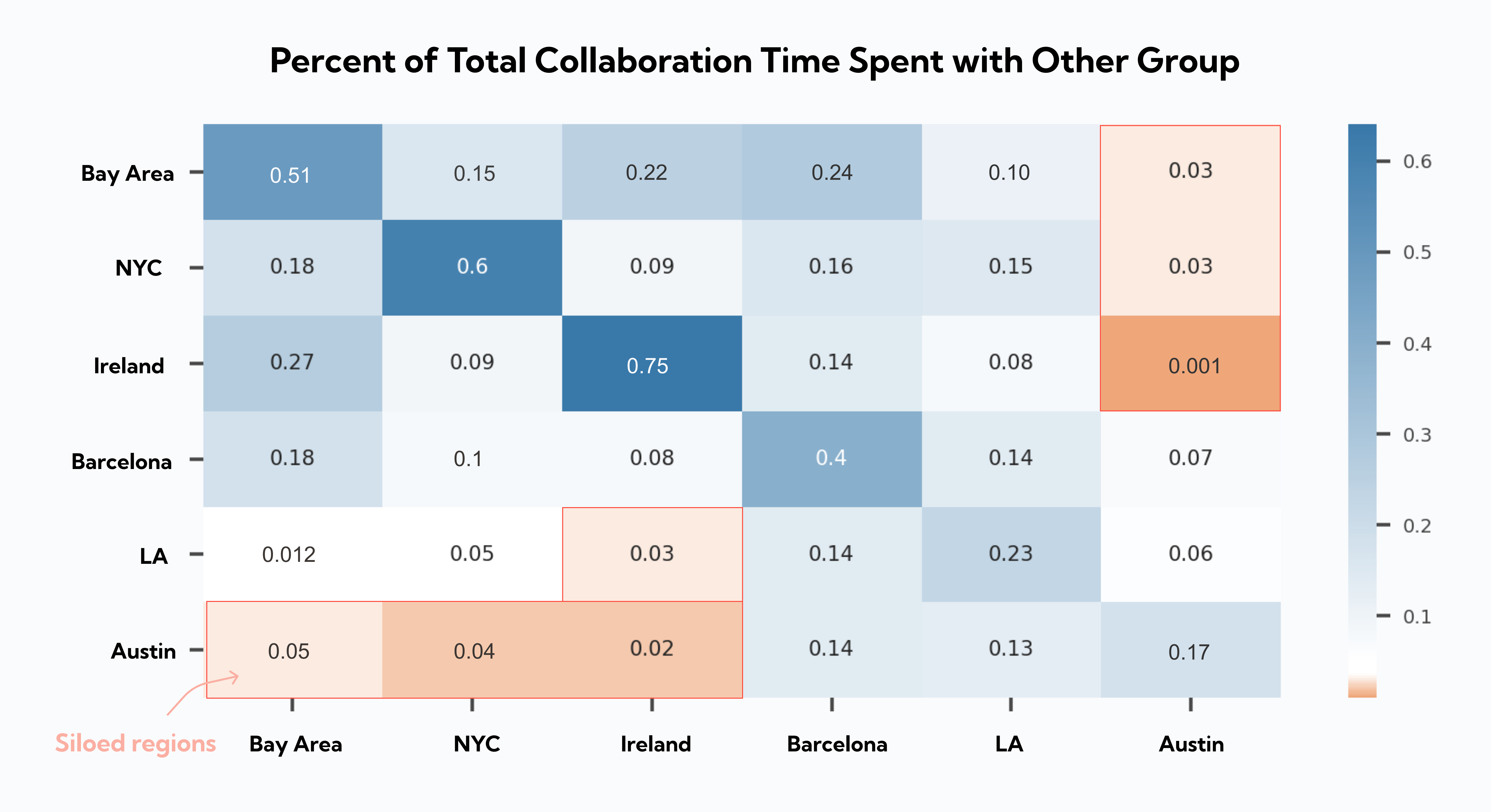
Organizational Network Analysis (ONA) has become the backbone of hybrid workforce management, transforming how companies understand collaboration patterns, identify bottlenecks, and optimize team dynamics. As remote and hybrid work models reshape the modern workplace, traditional survey-based approaches to understanding organizational behavior are giving way to passive data collection methods that provide real-time insights without disrupting employee workflows. (Worklytics)
The ONA software landscape in 2025 offers diverse solutions ranging from enterprise-grade platforms with extensive data connectors to open-source tools favored by academic researchers. With over 58% of the workforce now engaging in remote work, organizations need sophisticated analytics platforms that can capture collaboration patterns across digital touchpoints while maintaining strict privacy compliance. (Worklytics)
This comprehensive comparison examines four leading ONA platforms—Worklytics, Gephi, NodeXL, and Polinode—evaluating them against critical criteria that hybrid-workplace buyers prioritize: data integration capabilities, real-time dashboard functionality, privacy posture, scalability, and total cost of ownership. We'll analyze how each platform addresses specific use cases, from enterprise-scale hybrid analytics to academic network research, providing decision matrices and ROI scenarios to guide your vendor selection process.
| Platform | Best For | Key Strength | Data Sources | Starting Price |
|---|---|---|---|---|
| Worklytics | Enterprise hybrid workforce analytics | 25+ pre-built connectors with privacy-first architecture | Slack, Office 365, Google Workspace, Teams, Email, Calendar | Contact for pricing |
| Gephi | Academic research and custom analysis | Open-source flexibility with extensive plugin ecosystem | Manual data import, CSV, GraphML, GEXF | Free (open-source) |
| NodeXL | Excel-based network analysis | Native Excel integration for familiar workflows | Social media APIs, manual import, Excel data | Free basic; Pro from $390/year |
| Polinode | Survey-based organizational insights | Comprehensive survey tools with flexible data collection | Custom surveys, API integrations, file uploads | Contact for pricing |
Modern ONA platforms must seamlessly connect to the digital collaboration tools that define hybrid work. The most effective solutions offer pre-built connectors that can analyze collaboration patterns across email, calendar, messaging platforms, and project management tools without requiring manual data exports or complex API configurations. (Worklytics)
Hybrid work demands real-time visibility into collaboration patterns. Static reports generated monthly or quarterly fail to capture the dynamic nature of distributed teams. Leading platforms provide continuous analysis of collaboration network graphs, generating metrics that describe ways of work across teams in real-time. (Worklytics)
With 86% of employees believing it should be a legal requirement for employers to disclose monitoring tool usage, privacy-first design is non-negotiable. Effective ONA platforms must automatically anonymize or pseudonymize data at the source, ensuring compliance with GDPR, CCPA, and other data protection standards while still delivering actionable insights. (Worklytics)
As organizations grow and hybrid work patterns evolve, ONA platforms must scale to handle increasing data volumes and user bases. The ability to analyze historical collaboration networks going back multiple years while maintaining performance is crucial for understanding long-term organizational trends. (Worklytics)
The most valuable ONA platforms don't just visualize networks—they generate actionable insights that drive organizational improvements. This includes identifying collaboration bottlenecks, measuring manager effectiveness, tracking cross-functional collaboration, and understanding how interventions impact team dynamics over time. (Worklytics)
Why Choose Worklytics: Worklytics stands out as a purpose-built workplace insights platform that leverages existing corporate data to deliver real-time intelligence on how work gets done. The platform's strength lies in its extensive ecosystem of pre-built data connectors and privacy-first architecture, making it ideal for large enterprises managing complex hybrid workforces. (Worklytics)
Key Strengths:
Specialized Applications:
Considerations:
Best Fit: Large enterprises with complex hybrid workforces, established corporate tool ecosystems, and strong privacy compliance requirements.
Why Choose Gephi: Gephi remains the gold standard for open-source network analysis and visualization, offering unparalleled flexibility for researchers and organizations with specific analytical requirements. Its extensive plugin ecosystem and customizable visualization capabilities make it ideal for academic research and specialized network analysis projects.
Key Strengths:
Limitations:
Best Fit: Academic researchers, data scientists, and organizations with dedicated analytical teams requiring maximum customization flexibility.
Why Choose NodeXL: NodeXL bridges the gap between sophisticated network analysis and familiar Excel workflows, making ONA accessible to business users who prefer working within Microsoft's ecosystem. Its integration with Excel provides a comfortable entry point for organizations beginning their ONA journey.
Key Strengths:
Limitations:
Best Fit: Small to medium organizations with Excel-centric workflows, limited technical resources, and moderate network analysis requirements.
Why Choose Polinode: Polinode offers a comprehensive approach to organizational network analysis through custom surveys, data integrations, and powerful analytics. The platform excels at collecting relationship data through flexible survey tools while providing robust analytical capabilities. (Polinode)
Key Strengths:
Considerations:
Best Fit: Organizations prioritizing employee consent and participation in data collection, research institutions, and companies requiring custom relationship mapping.
Primary Requirements: Real-time insights, extensive data connectors, privacy compliance, scalability
Recommended Solution: Worklytics
Rationale: Worklytics' 25+ pre-built connectors, privacy-first architecture, and real-time analytics capabilities make it ideal for large enterprises managing complex hybrid workforces. The platform's ability to analyze historical data going back 3 years while maintaining compliance with major data protection regulations addresses key enterprise requirements. (Worklytics)
Primary Requirements: Flexibility, customization, cost-effectiveness, advanced visualization
Recommended Solution: Gephi
Rationale: Gephi's open-source nature, extensive plugin ecosystem, and advanced visualization capabilities provide the flexibility required for academic research and specialized analysis projects.
Primary Requirements: Familiar interface, moderate cost, ease of use
Recommended Solution: NodeXL
Rationale: NodeXL's Excel integration provides a comfortable entry point for small businesses with limited technical resources while offering sufficient analytical capabilities for basic network analysis.
Primary Requirements: Custom data collection, employee participation, relationship mapping
Recommended Solution: Polinode
Rationale: Polinode's comprehensive survey tools and flexible data integration capabilities make it ideal for organizations prioritizing employee consent and custom relationship mapping. (Polinode)
Worklytics ROI Scenario:
Gephi ROI Scenario:
NodeXL ROI Scenario:
Regardless of platform choice, organizations must prioritize data privacy and compliance. Worklytics' approach of anonymizing data at the source provides a model for privacy-first ONA implementation. (Worklytics) Organizations should establish clear data governance policies, obtain appropriate employee consent, and ensure compliance with relevant regulations before implementing any ONA solution.
Successful ONA implementation requires careful change management. Organizations should communicate the benefits of network analysis clearly, address employee concerns about monitoring, and demonstrate how insights will be used to improve work experiences rather than for punitive measures. (Worklytics)
Starting with a pilot program allows organizations to test platform capabilities, refine analytical approaches, and demonstrate value before full-scale implementation. This approach is particularly valuable for enterprise platforms like Worklytics, where the investment and organizational impact are significant.
The integration of artificial intelligence into ONA platforms is accelerating, with capabilities ranging from automated insight generation to predictive analytics. Worklytics' work in tracking AI adoption metrics demonstrates how ONA platforms are evolving to measure the impact of AI tools on organizational collaboration patterns. (Worklytics)
As hybrid work models mature, ONA platforms are developing more sophisticated approaches to measuring and optimizing distributed collaboration. Worklytics' Workday Intensity metrics represent an evolution in how platforms measure the unique characteristics of hybrid work environments. (Worklytics)
The trend toward privacy-preserving analytics will continue to shape ONA platform development. Solutions that can provide valuable insights while maintaining strict privacy controls will have significant competitive advantages in the evolving regulatory landscape.
The choice of ONA platform depends heavily on organizational context, technical requirements, and strategic objectives. For large enterprises managing complex hybrid workforces, Worklytics offers the most comprehensive solution with its extensive data connectors, privacy-first architecture, and real-time analytics capabilities. (Worklytics) Academic researchers and organizations requiring maximum customization flexibility will find Gephi's open-source approach most suitable, while small businesses may prefer NodeXL's Excel integration for its familiar interface and moderate cost.
Polinode serves organizations prioritizing survey-based data collection and custom relationship mapping, offering comprehensive survey tools and flexible data integration capabilities. (Polinode) The key to successful ONA implementation lies not just in platform selection, but in establishing clear objectives, ensuring proper data governance, and maintaining focus on actionable insights that drive organizational improvement.
As hybrid work continues to evolve, the organizations that invest in sophisticated ONA capabilities will be best positioned to optimize their collaboration patterns, improve team effectiveness, and maintain competitive advantages in an increasingly distributed work environment. The platforms reviewed here represent the current state of the art, but the rapid pace of innovation in workplace analytics suggests that capabilities will continue to expand, making ONA an increasingly valuable component of organizational strategy. (Worklytics)
Organizational Network Analysis (ONA) is a data-driven approach that maps and analyzes collaboration patterns, communication flows, and relationships within organizations. For hybrid workforces, ONA is crucial because traditional survey-based methods can't capture the complex digital collaboration patterns that emerge when teams work across different locations and time zones. It helps identify bottlenecks, optimize team dynamics, and understand how work actually flows through the organization.
Worklytics stands out with pre-built data connectors for over 25 common work and collaboration platforms including Slack, Google Workspace, Office 365, Teams, Asana, and Bitbucket. Unlike tools like Gephi which require manual data preparation, Worklytics can automatically pull and analyze collaboration data going back up to 3 years. The platform also automatically anonymizes or pseudonymizes data to protect employee privacy and ensure compliance, making it more enterprise-ready than open-source alternatives.
Essential privacy features include automatic data anonymization or pseudonymization, compliance with regulations like GDPR and CCPA, and transparent disclosure of monitoring activities. Worklytics automatically handles data anonymization to protect employee privacy, while tools like Polinode offer flexible survey integration for consent management. With 86% of employees believing employers should legally disclose monitoring tool usage, transparency and robust privacy controls are critical for successful ONA implementation.
Yes, advanced ONA platforms can analyze historical collaboration data extensively. Worklytics can generate ONA graphs analyzing collaboration networks going back up to 3 years into historical records. This historical analysis reveals trends in team connectivity, identifies changes in collaboration patterns over time, and helps measure the impact of organizational changes. The platform also introduces new metrics like Workday Intensity, which measures digital work time as a percentage of overall workday span, providing insights into hybrid work patterns.
Open-source tools like Gephi and NodeXL offer powerful visualization capabilities and are cost-effective but require significant technical expertise for data preparation, analysis, and maintenance. Commercial platforms like Worklytics and Polinode provide pre-built integrations, automated data processing, real-time dashboards, and enterprise-grade security features. While open-source tools have lower upfront costs, commercial solutions often provide better total cost of ownership for organizations lacking specialized data science resources.
Modern ONA platforms use multiple metrics to assess team health including collaboration frequency, network density, response times, and cross-functional connectivity. Worklytics measures team health through various dimensions including workday intensity, work-life balance, manager effectiveness, and team connectivity patterns. These tools can identify collaboration bottlenecks, measure the fluidity of collaborative relationships, and analyze how workgroups form across organizational boundaries, providing actionable insights for improving team performance.