I’ve often wondered whether how hard people work impacts their overall performance. Do people who work longer hours tend to do better? How about people who start work really early? Work a lot of weekends?
Here at Worklytics, we partnered with the CTO of a high-growth, multinational telecom company to pinpoint what sets top-performing engineers apart from the rest.
The Question: What do top-performers do differently?
To answer that, we first needed a consistent definition of performance. In this case, we used performance review scores as our benchmark, and compared behavioral patterns between top-rated engineers and the rest of the team.
By analyzing data from the digital collaboration tools,* Worklytics is able to return objective insights on how people are getting work done — including:
We then marry those behavioral insights with performance review scores to understand how top-performers work differently.
Here’s an example of what that looks like for a team of 217 IC-level engineers.
*For this analysis, we pulled anonymized metadata from work email & calendar, Slack, GitHub, and Zoom.
The total amount of time spent working was very weakly correlated to performance scores, as was the amount of overtime that individuals worked.
Somewhat surprisingly, we found that regularly working on the weekend had a slightly negative correlation with performance scores. Ditto for regularly working late evenings.
For this team, the early bird gets the worm. We saw that engineers who started work early in the morning were more likely to have top performance scores than those who logged on later in the day.
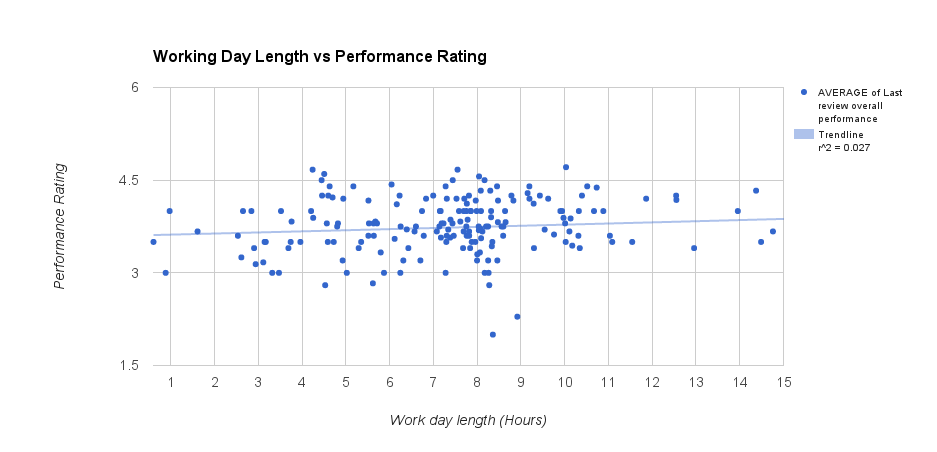
This is one of the biggest misconceptions we see in knowledge work: people often assume that top performers are “always on.”
But what the data suggests is something more nuanced. Top performers aren’t logging more hours, they’re allocating their time differently, and they’re spending a higher percentage of their day doing work that moves outcomes forward.
The strongest predictor of performance was work intensity, which we measured as:
Work Intensity = (amount of work done) / (time spent working)
As you’d expect, people who did more with their time at work tended to score better – and, interestingly, that held true regardless of the total number of hours they put in each day.
Here, we measured the amount of work done by looking at the units of active collaboration that a person logged each day. For instance, we’d count the number of emails sent, comments entered into a shared doc or code commits made. Engineers with high performance review scores tended to push more frequent code commits than those with lower scores.
A major insight from this analysis is that performance isn’t explained by time alone, it’s explained by how that time is spent.
This is where the distinction between “working longer” and “working better” becomes measurable. Top performers are not necessarily producing more activity, they’re producing more meaningful output per unit of time.
One of the strongest predictors of a low performance score was the amount of time spent in meetings each week. The more meetings that an engineer attended, the lower their performance score was likely to be.
This is consistent with a broader pattern we see across teams: meetings often create the illusion of productivity while quietly reducing execution time, focus, and throughput.
When weekend work and late-night work show up as negative correlations, it usually points to something important: those behaviors are often signals of deeper issues, such as:
Long hours can sometimes reflect urgency — but they can also reflect inefficiency, overload, or system-level friction.
Before we jump to universal conclusions, it’s important to acknowledge that what’s true for IC-level engineers may not apply to other roles.
For example, managers often have more meetings by nature of their responsibilities. Teams working across time zones may also have longer work spans even if they aren’t “working more.”
That’s why behavioral analytics is most useful when it’s tied to role context, team structure, and expectations.
As always, we have to be mindful of confounding factors. For example, in the excerpt of the analysis above, we did not take into consideration people’s seniority within the organization. More tenured team members may feel more comfortable declining meeting invites than those who are newer to the organization.
This analysis was focused on Individual Contributors, but you’d expect the picture might look quite different if we added in Team Managers and Directors. By nature of their role, Managers typically have more meetings than Individual Contributors; Managers with highly distributed teams may be required to work longer hours to cover multiple time zones.
Another critical thing to keep in mind is that performance review scores are a subjective measure of performance. Ratings can be heavily influenced by how managers and peers perceive a person has performed and those perceptions may be skewed by different biases.
One of the risks in any performance analysis is over-indexing on output without considering sustainability.
If weekend work, late nights, and excessive meetings are negatively correlated with performance, they are not just productivity signals. They are also potential well-being signals.
This is where measuring employee engagement and health becomes critical.
Behavioral analytics does not only help identify what drives performance. It also helps surface leading indicators of burnout and disengagement, such as:
These patterns often appear weeks or months before performance scores change.
Worklytics enables organizations to quantify these behavioral indicators at scale using anonymized metadata from collaboration tools. Instead of relying solely on periodic survey sentiment, leaders can continuously monitor structural factors that influence both engagement and execution capacity.
For example, teams can:
When leaders understand how work patterns influence both outcomes and well-being, they can design healthier operating models. That might mean reducing recurring meetings, protecting focus blocks, clarifying priorities, or rebalancing workload distribution.
High performance achieved through unsustainable effort is fragile. High performance supported by healthy, well-designed work systems is durable.
If you want to understand how work patterns are shaping both performance and employee well-being in your organization, explore how Worklytics can provide objective, actionable insight into engagement, workload balance, and collaboration effectiveness.
Schedule a demo to see how behavioral analytics can help your team build a healthier, higher-performing operating model.
The biggest takeaway for this team’s CTO was that top-performing engineers weren’t working longer, but they were working smarter. And, for this team, working smarter meant spending less time in meetings.
As a result of this analysis, the company embarked on a https://www.worklytics.co/meeting-effectiveness project with an eye toward culling 25% of meetings from engineers’ calendars by the next quarter. Stay tuned for the results.