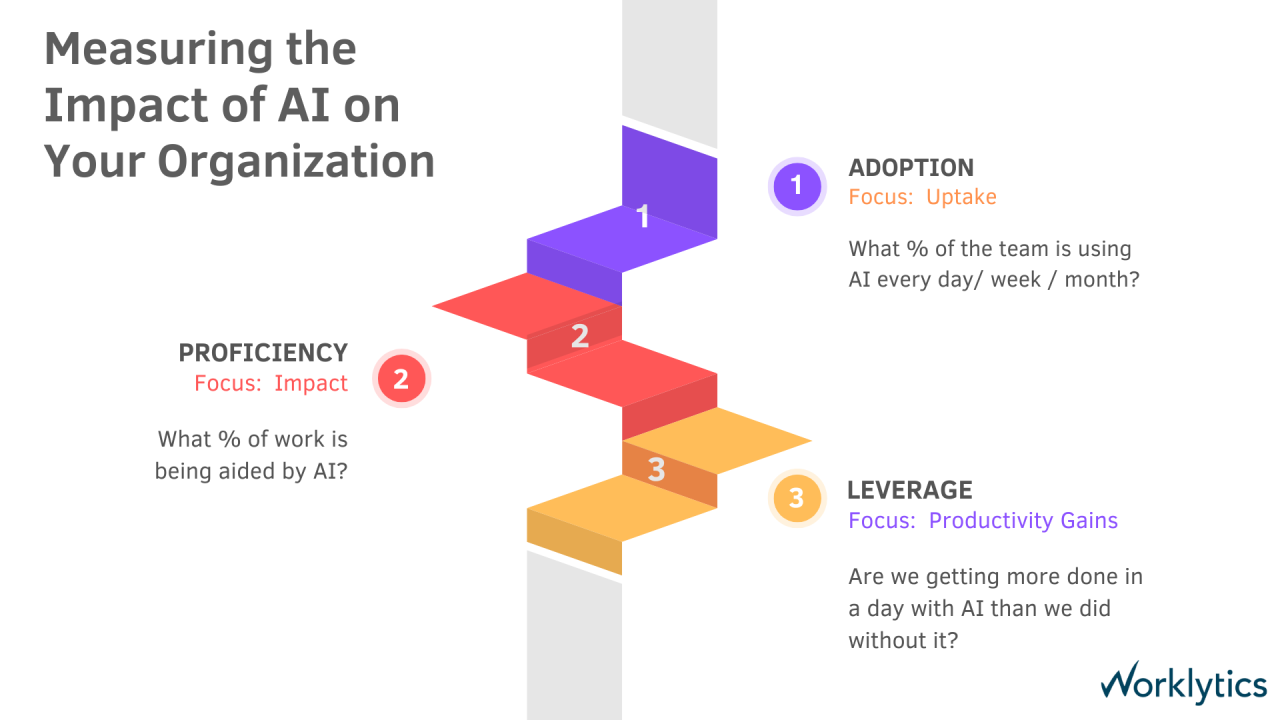
The most effective KPIs for GenAI adoption in hybrid teams track four dimensions: adoption breadth, workflow integration, performance impact, and equity across locations and roles. With 75% of global knowledge workers now using AI tools regularly, organizations need metrics beyond license counts to understand actual value creation in distributed environments.
• Core metrics to track: Light vs. Heavy Usage Rate, Weekly Copilot Minutes, Percentage of Work Activities with AI, and Manager AI Usage Rate by department
• Critical gaps to monitor: New-hire versus tenured employee usage patterns and adoption disparities between remote and office workers
• Performance indicators: Document completion speed improvements and time savings per process, with some teams saving 25 hours annually on meeting-related tasks
• Benchmark targets: AI adoption rates vary widely across departments, with leading teams achieving 80% usage while others lag below 20%
• Key enablers: Manager support drives 9x higher impact perception among employees who receive active leadership backing for AI use
Hybrid leaders need clear Generative AI adoption KPIs to see whether new copilots are lifting performance or just adding license cost. This post shows how to measure what matters.
The workplace has fundamentally changed. With 75% of global knowledge workers now using AI tools regularly, organizations are scrambling to understand where they stand compared to industry peers. Yet the shift to hybrid work has made measuring AI adoption even more complex.
Over 69% of companies stated they are investing in GenAI and evaluating its impact on the workforce. But here's the problem: traditional metrics don't capture the nuanced reality of distributed teams. When half your workforce connects remotely and collaboration happens across time zones, simple license counts tell you nothing about actual value creation.
The stakes couldn't be higher. 50% of workers say their company has not offered any training or guidelines on how to use GenAI. Without proper measurement frameworks, organizations risk investing millions in tools that employees don't understand, can't access equally, or simply don't use effectively.
Generic adoption metrics create dangerous blind spots in hybrid environments. The 95% failure rate for enterprise AI solutions represents the clearest manifestation of this measurement gap. Organizations pour resources into AI initiatives only to discover their metrics missed critical adoption barriers.
The problem runs deeper than poor ROI. Employees who strongly agree their manager supports AI use are nearly nine times as likely to strongly agree that it helps them do what they do best every day. Yet most organizations track licenses, not manager engagement. They count logins, not meaningful usage patterns.
Writer Survey finds ~2 out of 3 C-suite say Generative AI adoption has caused division at their organization, with 42% saying it's tearing their company apart. These tensions emerge precisely because one-size-fits-all metrics fail to reveal adoption disparities across teams, locations, and roles. Remote workers may struggle with tool access while office workers thrive. Junior employees might embrace AI enthusiastically while senior staff resist change.
Without metrics tailored to hybrid realities, leaders fly blind. They can't see which teams need support, where training gaps exist, or how work location affects adoption success.
Effective GenAI measurement in hybrid teams requires tracking four interconnected dimensions that capture both breadth and depth of adoption.
Breadth metrics reveal adoption spread across your organization. AI Prompts Per Employee (Monthly) shows basic engagement levels, while tool diversity indicates whether teams explore multiple AI capabilities or stick to familiar features.
Depth metrics measure usage intensity beyond simple counts. Usage Depth Index (Complexity Measurement) reveals whether employees use advanced features or just basic functions. This dimension separates surface-level experimentation from genuine workflow integration.
Performance impact metrics connect AI usage to business outcomes. Tools like Organizational Network Analysis (ONA), which map collaboration across email, Slack, and project tools, reveal how knowledge flows and where silos exist. These metrics show whether AI actually improves how work gets done.
Equity metrics surface adoption gaps that threaten long-term success. By tracking usage across departments, tenure levels, and work locations, organizations identify which groups need additional support before disparities become entrenched.
Together, these four dimensions create a comprehensive view that generic metrics miss.
Successful hybrid organizations focus on eight core KPIs that balance simplicity with insight:
This extends beyond user counts to examine workflow penetration.
Assess whether AI improves collaboration outcomes, not just speeds them up. Track metrics like response times, iteration cycles, and stakeholder satisfaction.
Leadership adoption predicts team success. Organizations with high manager engagement see dramatically better outcomes across all other metrics.
This reveals whether AI democratizes capabilities or creates new divides.
Key takeaway: These eight KPIs work together to reveal adoption patterns that single metrics miss, helping leaders identify both successes and gaps before they impact business outcomes.
Adoption patterns vary dramatically across organizational dimensions, creating hidden performance gaps that aggregate metrics obscure.
Manager Usage per Department serves as a critical leading indicator. When managers actively use AI tools, their teams follow. Yet many organizations discover stark departmental differences, with some leadership teams fully engaged while others remain skeptical.
AI adoption rates across departments and industries show some teams achieving 80%+ usage while others lag below 20%. These disparities often correlate with factors leaders overlook: access to training, tool relevance to daily work, and cultural attitudes toward technology.
Tenure patterns reveal another critical dynamic. New hires sometimes embrace AI eagerly, using it to accelerate their learning curve. But without proper support, they may develop ineffective habits. Meanwhile, experienced employees might resist initially but become powerful advocates once they see relevant use cases.
Only 28% of employees in organizations that have begun implementing AI technologies strongly agree their manager actively supports their team's use of the technology. This manager support gap directly impacts adoption success across all demographic segments.
By tracking these dimensional metrics separately, organizations can target interventions precisely. Marketing might need use case workshops while engineering requires advanced training. Remote workers may need different support than office-based teams. Generic, company-wide initiatives fail because they ignore these crucial differences.
Three foundational elements determine whether KPIs reflect genuine adoption or just compliance theater.
Manager support drives everything else. Within organizations that are investing in AI technology, employees who strongly agree their manager supports AI use are nearly nine times as likely to strongly agree that it helps them do what they do best every day. Without visible manager engagement, even the best tools and training fail.
Training quality separates successful adoption from expensive experimentation. Manager Usage per Department often correlates directly with training investment. Teams that receive role-specific, hands-on training show markedly different usage patterns than those given generic introductions.
Privacy-first approaches build the trust necessary for authentic adoption. Management support is a key aspect of technology adoption that employees find important. When workers fear surveillance or judgment, they engage in "productivity theater" rather than genuine experimentation. Privacy-first analytics that anonymize and aggregate data encourage honest usage while still providing leaders with actionable insights.
These enablers don't just improve adoption rates; they fundamentally change what your KPIs measure. With strong manager support, training, and privacy protection, metrics reflect genuine value creation rather than forced compliance.
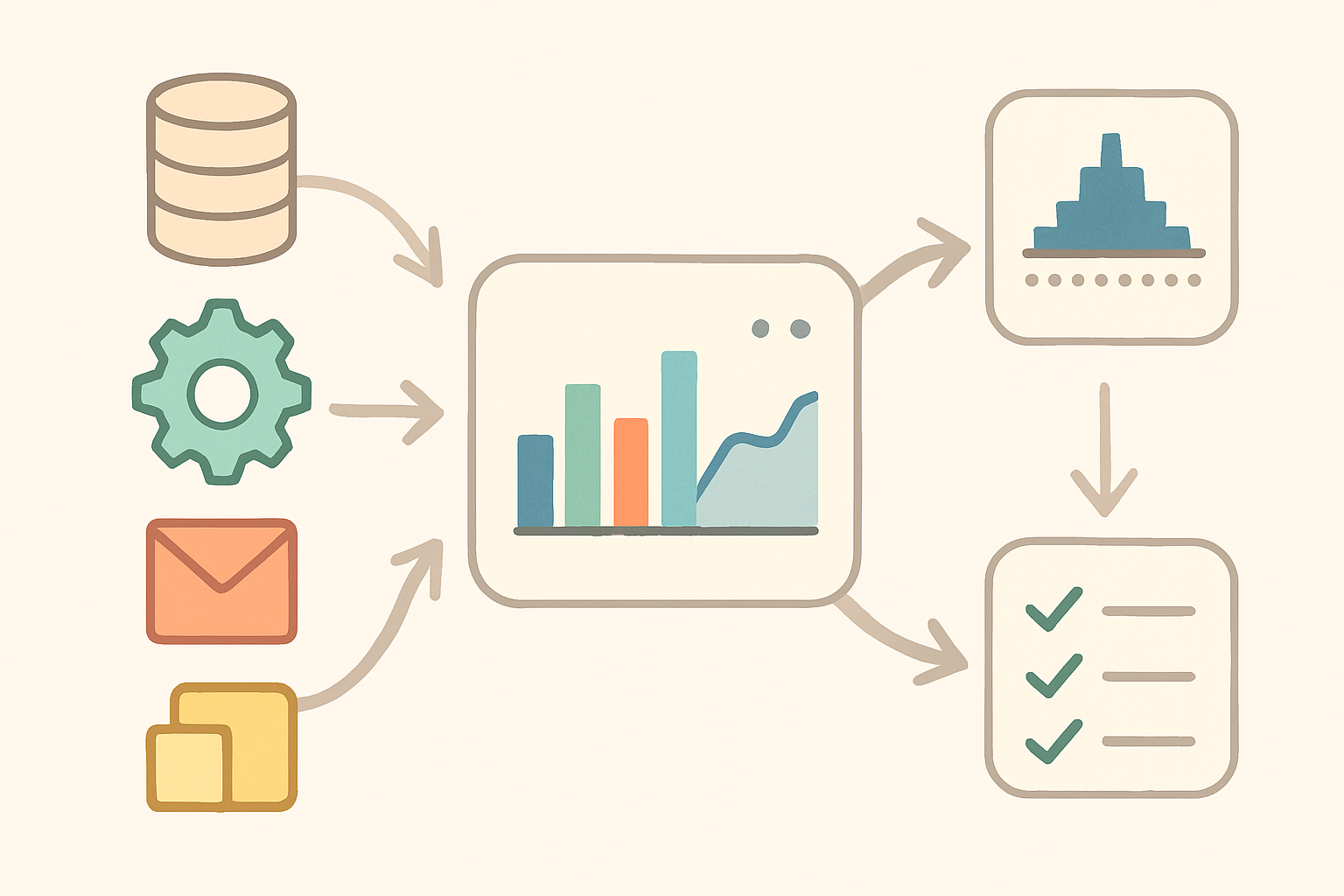
Raw KPIs mean nothing without context and comparison. Leading organizations transform metrics into action through real-time visibility and strategic benchmarking.
Benchmark your organization's AI adoption against industry peers to see where you stand and where to improve. This external perspective reveals whether your 40% adoption rate leads or lags your sector. Industry benchmarks also highlight which use cases deliver value in similar contexts.
With Worklytics, you can track adoption and usage by team, tool, and role while identifying power users and lagging teams. Real-time dashboards transform static reports into living tools that guide daily decisions. Managers can spot adoption problems before they become crises.
The AI in Workforce Management Market alone is projected to grow from $2.3 billion in 2024 to $14.2 billion by 2033. Organizations that build robust measurement and action systems now will capture disproportionate value from this growth.
Effective dashboards do three things well:
• Provide role-appropriate views (executives see trends, managers see team details)
• Enable drill-down from company metrics to individual team performance
• Connect usage data to business outcomes, not just activity levels
By combining internal dashboards with external benchmarks, leaders can set realistic targets, identify best practices, and accelerate adoption where it matters most.
The path to successful GenAI adoption in hybrid teams requires abandoning one-size-fits-all metrics for tailored, multi-dimensional measurement.
Start with the foundation: There are six key metrics that have most commonly helped companies measure the effectiveness and impact of Hybrid/Return to Office programs. Apply this same rigor to AI adoption. Build from proven frameworks but customize for your unique context.
Focus on the metrics that matter: Light vs. Heavy Usage Rate reveals more than license counts ever could. Track adoption breadth, usage depth, performance impact, and equity gaps. These four dimensions provide the complete picture generic metrics miss.
Remember that Measuring AI Adoption on Your Team requires more than just counting logins. It demands understanding how AI transforms work patterns, where adoption succeeds, and which teams need support.
The organizations that thrive won't be those with the most AI tools or the biggest budgets. They'll be those that measure what matters, act on insights quickly, and ensure no team gets left behind in the AI transformation.
For teams ready to move beyond surface-level metrics, Worklytics provides privacy-first analytics that reveal how AI adoption really impacts hybrid team performance. By connecting data from collaboration tools while protecting individual privacy, Worklytics helps leaders identify adoption patterns, benchmark against peers, and accelerate value creation where it matters most.
Measuring GenAI adoption in hybrid teams is challenging due to the complexity of distributed work environments. Traditional metrics often fail to capture the nuanced reality of remote and in-office collaboration, leading to blind spots in understanding true adoption and value creation.
One-size-fits-all metrics fail in hybrid environments because they overlook the diverse needs and behaviors of distributed teams. These metrics often miss critical adoption barriers, such as differences in tool access, training gaps, and varying levels of manager support, which can lead to inaccurate assessments of AI adoption success.
A meaningful GenAI KPI framework includes breadth metrics to measure adoption spread, depth metrics to assess usage intensity, performance impact metrics to link AI usage to business outcomes, and equity metrics to identify adoption gaps across departments, tenure levels, and work locations.
Hybrid teams should focus on KPIs such as Light vs. Heavy Usage Rate, Weekly Copilot Minutes, Percentage of Work Activities with AI, Time Savings per Process, Document Completion Speed, Collaboration Quality Score, Manager AI Usage Rate, and New-Hire vs. Tenured Usage Gap to gain comprehensive insights into AI adoption.
Worklytics provides privacy-first analytics that connect data from collaboration tools to reveal AI adoption patterns. By benchmarking against industry peers and offering real-time dashboards, Worklytics helps leaders identify adoption gaps, track usage by team and role, and accelerate value creation in hybrid teams.
1. https://www.worklytics.co/resources/2025-ai-adoption-benchmarks-employee-usage-statistics
3. https://worklytics.co/resources/2025-employee-ai-adoption-benchmarks-by-department-industry
4. https://my.idc.com/getdoc.jsp?containerId=US52489724
5. https://www.uipath.com/resources/automation-analyst-reports/global-knowledge-worker-survey
6. https://mlq.ai/media/quarterly_decks/v0.1_State_of_AI_in_Business_2025_Report.pdf
7. https://www.gallup.com/workplace/694682/manager-support-drives-employee-adoption.aspx
8. https://workplaceintelligence.com/ai-adoption-study/
9. https://www.worklytics.co/resources/measuring-ai-adoption-team-5-new-kpis-2025-manager-scorecard
10. https://www.worklytics.co/blog/6-kpis-to-make-hybrid-work-a-success
11. https://www.econstor.eu/bitstream/10419/316778/1/41449_2024_Article_440.pdf