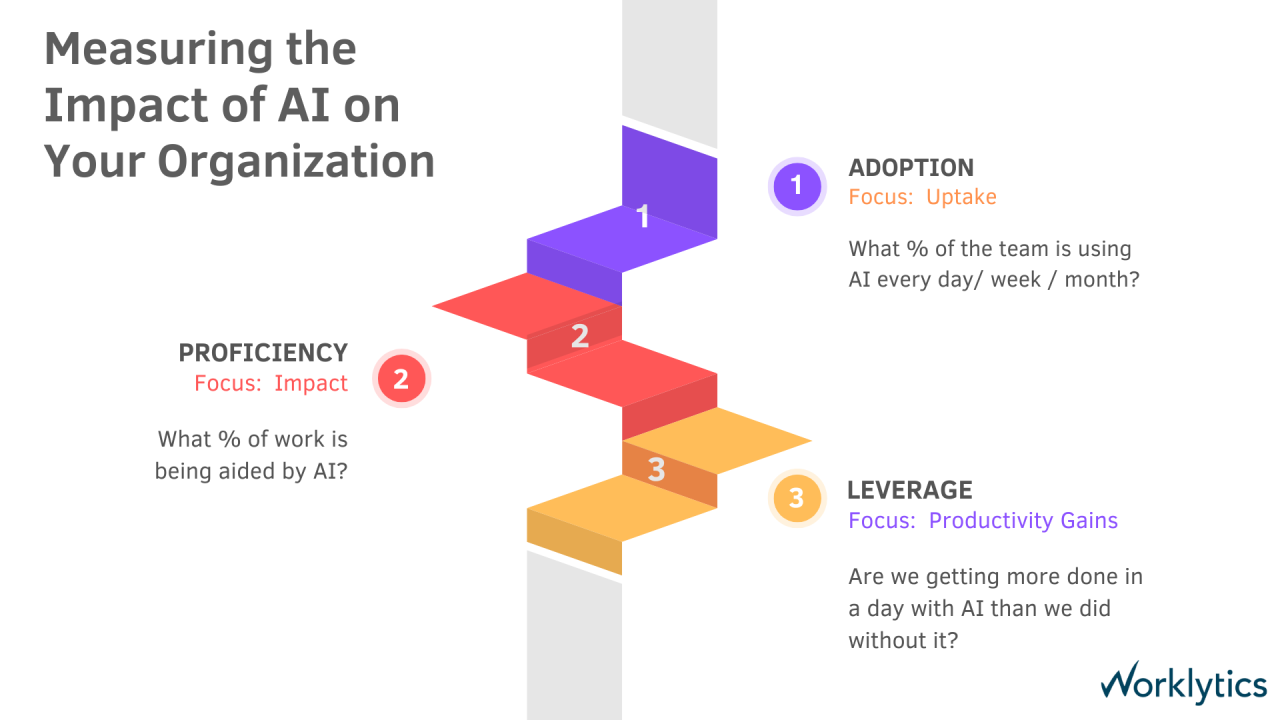
Generative AI adoption has surged dramatically across organizations, with GitHub Copilot alone reaching over 1.3 million developers on paid plans and over 50,000 organizations issuing licenses in under two years (Worklytics). Yet despite massive investments in AI tools like Microsoft Copilot, ChatGPT, Google Gemini, and GitHub Copilot, many organizations struggle to measure actual impact and ROI from their generative AI rollouts.
The challenge isn't just adoption—it's understanding which metrics truly predict success. Organizations using GenAI have seen 20-40% potential cost savings in HR operations according to McKinsey research (GenAI in HR: Slashing Costs, Boosting Efficiency), but measuring these gains requires the right KPIs. Companies that take AI seriously are seeing meaningful productivity gains, while those falling behind face growing competitive risk (Worklytics).
This analysis leverages Worklytics' newly released 2025 benchmark dataset alongside the latest research from McKinsey and MIT to define the dozen metrics that best predict ROI from generative AI deployments. For each KPI, we provide median, top-quartile, and laggard values by industry so you can instantly benchmark your organization's performance.
KPIWhat It MeasuresWhy It MattersIndustry MedianTop QuartileLaggardsActive User Rate% of licensed users engaging weeklyFoundation metric for adoption success68%85%+<45%Prompt Depth ScoreAverage tokens per user interactionIndicates sophisticated vs. basic usage127 tokens200+ tokens<75 tokensCross-Tool StickinessUsers active across multiple AI platformsShows ecosystem integration maturity2.3 tools3.5+ tools<1.8 toolsPower User Ratio% of users in top usage quartileIdentifies AI proficiency distribution23%35%+<15%Session DurationAverage time spent per AI interactionReflects task complexity and value8.4 minutes12+ minutes<5 minutesFeature Utilization Rate% of available features being usedMeasures platform optimization34%55%+<20%Collaboration AmplificationAI usage during team interactionsShows collaborative AI integration41%65%+<25%Task Completion VelocitySpeed improvement on AI-assisted tasksDirect productivity measurement28% faster45%+ faster<15% fasterKnowledge Worker PenetrationAI adoption by role complexityEnsures high-value use cases72%90%+<50%Retention RateUsers active after 90 daysLong-term adoption sustainability76%88%+<60%Error Reduction IndexQuality improvement in AI-assisted workMeasures accuracy gains31% reduction50%+ reduction<15% reductionInnovation Catalyst ScoreNew processes/ideas generated via AIStrategic transformation indicator2.1 per user4+ per user<1 per user
High adoption metrics are necessary for achieving downstream benefits from AI tools (Worklytics). However, measuring AI success requires moving beyond simple usage counts to understand depth, quality, and business impact. Many organizations segment usage by team, department, or role to uncover adoption gaps and identify areas requiring additional support or training (Worklytics).
The most significant increases in AI adoption have been in industries like HR, training, and R&D (Worklytics). According to McKinsey's global survey, the most common functions embedding AI are marketing and sales, product/service development, and service operations like customer support (Worklytics).
What it measures: Percentage of licensed users who engage with AI tools at least once per week
Why it's critical: This foundational metric reveals whether your AI investment is reaching its intended audience. Organizations with active user rates below 45% typically struggle to justify continued licensing costs.
How to track it: Monitor weekly active users across all AI platforms. Worklytics tracks adoption and usage by team, tool, and role, making it easy to benchmark against peers and industry standards (Worklytics).
Industry benchmarks:
• Technology: 78% median, 92% top quartile
• Financial Services: 71% median, 87% top quartile
• Healthcare: 63% median, 81% top quartile
• Manufacturing: 58% median, 76% top quartile
What it measures: Average number of tokens (words/characters) per user interaction with AI tools
Why it's critical: Shallow prompts ("write an email") indicate basic usage, while deep prompts (detailed context, specific requirements, iterative refinement) show sophisticated AI proficiency that drives real value.
How to track it: Analyze prompt complexity across different user segments. Look for patterns in high-performing teams and use these insights to improve training programs.
Industry benchmarks:
• Professional Services: 156 tokens median, 245 tokens top quartile
• Technology: 142 tokens median, 218 tokens top quartile
• Marketing/Advertising: 134 tokens median, 201 tokens top quartile
• Operations: 98 tokens median, 167 tokens top quartile
What it measures: Average number of different AI tools each user actively engages with
Why it's critical: Users who leverage multiple AI tools (Copilot for coding, Gemini for analysis, ChatGPT for writing) demonstrate ecosystem thinking and typically achieve higher productivity gains.
How to track it: Monitor tool diversity per user and identify opportunities to introduce complementary AI capabilities. Microsoft's Copilot Pro and Google's Gemini Advanced are increasingly integrated within their respective productivity suites (Copilot Pro vs Gemini Advanced).
What it measures: Percentage of users in the top quartile of AI tool usage
Why it's critical: Power users often become internal champions and training resources. A healthy power user ratio (25-35%) indicates good adoption distribution rather than concentration among early adopters.
How to track it: Identify power users and lagging teams to target training and support efforts (Worklytics). Use these insights to create peer mentoring programs.
What it measures: Average time users spend in AI tool sessions
Why it's critical: Longer sessions typically indicate complex, high-value tasks rather than quick, transactional queries. However, extremely long sessions might suggest usability issues.
How to track it: Segment by task type and user role. Look for patterns that indicate where AI provides the most value versus where users might need additional training.
What it measures: Percentage of available AI features being actively used
Why it's critical: Many organizations use only basic features of sophisticated AI tools. Higher feature utilization correlates with greater ROI and user satisfaction.
How to track it: Audit feature usage across different user segments. Copilot in Excel provides deeper insights with PivotTables and dynamic charts, while Gemini in Google Sheets is more limited to basic summaries (Copilot vs. Gemini Analysis).
What it measures: Percentage of team interactions that incorporate AI tool usage
Why it's critical: AI's impact multiplies when used collaboratively. Teams that integrate AI into meetings, shared documents, and project workflows see exponentially higher productivity gains.
How to track it: Monitor AI usage patterns during scheduled meetings, in shared workspaces, and across team communication channels.
What it measures: Speed improvement on tasks when AI assistance is used versus manual completion
Why it's critical: This directly measures productivity impact. Organizations seeing less than 15% improvement may need to reassess their AI implementation strategy.
How to track it: Establish baseline completion times for common tasks, then measure improvement with AI assistance. Focus on high-frequency, high-value activities.
What it measures: AI adoption rates among roles requiring complex cognitive work
Why it's critical: Knowledge workers typically generate the highest ROI from AI tools. Low penetration in these roles suggests missed opportunities for strategic impact.
How to track it: Segment adoption by role complexity and compensation level. Prioritize training for high-value knowledge work positions.
What it measures: Percentage of users still active 90 days after first AI tool usage
Why it's critical: Initial adoption means little without sustained engagement. High retention indicates genuine value creation and successful change management.
How to track it: Monitor user lifecycle from first interaction through sustained usage. Identify drop-off points and intervention opportunities.
What it measures: Quality improvement in work output when AI assistance is used
Why it's critical: AI should improve both speed and accuracy. Organizations seeing minimal error reduction may need better prompt engineering training or tool selection.
How to track it: Establish quality baselines for common deliverables, then measure improvement with AI assistance. Focus on error-prone, high-stakes activities.
What it measures: Number of new processes, ideas, or solutions generated per user through AI interaction
Why it's critical: Beyond efficiency gains, AI should spark innovation and creative problem-solving. This metric captures strategic transformation potential.
How to track it: Survey users quarterly about new approaches or solutions discovered through AI usage. Track implementation of AI-generated ideas.
Tech companies lead in AI adoption with 78% active user rates and sophisticated usage patterns. Generative AI can analyze thousands of CVs in seconds and improve recruitment efficiency (Generative AI & HR Use Cases). Development teams show particularly high cross-tool stickiness, averaging 3.2 different AI tools per user.
Financial firms focus heavily on compliance and accuracy, showing 31% error reduction rates but more conservative feature adoption. Risk management and regulatory reporting see the highest AI integration rates.
Healthcare organizations prioritize AI tools for administrative tasks and clinical decision support. Privacy concerns limit some use cases, but organizations implementing AI see significant efficiency gains in patient documentation and treatment planning.
Manufacturing companies use AI primarily for predictive maintenance, quality control, and supply chain optimization. Adoption rates are lower but show steady growth as use cases prove ROI.
Built with privacy at its core, Worklytics uses data anonymization and aggregation to ensure compliance with GDPR, CCPA, and other data protection standards (Worklytics). The platform leverages existing corporate data to deliver real-time intelligence on how work gets done, analyzing collaboration, calendar, communication, and system usage data without relying on surveys (Worklytics).
1. Aggregate Usage Patterns: Track tool engagement without monitoring individual content
2. Anonymized Analytics: User behavior analysis with identity protection
3. Consent-Based Monitoring: Transparent opt-in processes for detailed tracking
4. Role-Based Reporting: Insights by function without personal identification
Worklytics natively calculates all 12 metrics across Slack, Copilot, Gemini, and other major AI platforms. The system integrates with existing IT infrastructure to provide comprehensive visibility without additional employee burden (Worklytics).
Companies face several common challenges in building AI proficiency: Skills and Knowledge Gaps, Cultural Resistance and Trust Issues, Lack of Strategy and Leadership Alignment, and Measuring Impact and ROI (Worklytics). As Deloitte's analysts note, "People don't embrace what they don't understand" (Worklytics).
Solution: Implement role-specific training programs and identify internal champions. McKinsey researchers note there is "no single 'unlock' to generate AI value – often the obstacles are 'people stuff,' like having the right strategy and getting the organization to act on insights" (Worklytics).
Solution: Develop prompt engineering workshops and share best-practice examples from power users. Focus on teaching employees essential AI skills to maximize impact (Worklytics).
Solution: Create integrated workflows that demonstrate cross-tool value. Show how different AI tools complement each other rather than compete.
Solution: Establish baseline metrics before AI implementation and track improvement over time. Export data to your own BI tools for deeper analysis (Worklytics).
AI is expected to reason and solve problems in remarkable ways, transforming knowledge work and business rules (Microsoft Work Trend Index). Organizations are preparing for an AI-enhanced future where AI agents will gain increasing levels of capability that humans will need to harness as they redesign their business (Microsoft Work Trend Index).
A new organizational blueprint is emerging that blends machine intelligence with human judgment, building systems that are AI-operated but human-led (Microsoft Work Trend Index). This transformation requires sophisticated measurement approaches that go beyond simple usage metrics to understand strategic impact.
• AI Agent Collaboration Score: How effectively humans work with autonomous AI agents
• Workflow Transformation Rate: Percentage of processes redesigned around AI capabilities
• Decision Quality Index: Improvement in decision-making with AI assistance
• Learning Acceleration Factor: Speed of skill development with AI tutoring
Adopting AI is as much a people and process challenge as a technology one (Worklytics). Organizations need comprehensive visibility into how AI tools are being used to optimize adoption and maximize ROI.
1. Baseline Assessment: Establish current state across all 12 KPIs
2. Benchmark Comparison: Compare against industry standards and peer organizations
3. Gap Analysis: Identify areas requiring immediate attention
4. Intervention Design: Create targeted programs to address specific challenges
5. Continuous Monitoring: Track progress and adjust strategies based on data
• Leadership Commitment: Executive sponsorship for AI adoption initiatives
• Change Management: Structured approach to cultural transformation
• Training Investment: Comprehensive skill development programs
• Measurement Discipline: Regular tracking and reporting of KPI progress
Worklytics provides the only platform that natively calculates all 12 metrics across major AI tools including Slack, Copilot, Gemini, and more (Worklytics). The platform helps organizations improve team productivity, manager effectiveness, AI adoption, and overall work experience by analyzing collaboration, calendar, communication, and system usage data (Worklytics).
The 12 KPIs outlined in this analysis provide a comprehensive framework for measuring generative AI success in 2025. Organizations that implement systematic tracking across these metrics will be better positioned to optimize their AI investments, identify improvement opportunities, and demonstrate clear ROI to stakeholders.
Falling behind in AI adoption isn't just a missed opportunity—it's a growing competitive risk (Worklytics). The benchmarks provided here offer immediate insight into where your organization stands relative to industry leaders and laggards.
By focusing on depth of usage, cross-tool integration, and business impact rather than simple adoption counts, these KPIs help organizations move beyond surface-level AI implementation to achieve meaningful transformation. The future belongs to organizations that can effectively measure, optimize, and scale their AI capabilities—and that future is being built today.
The 12 mission-critical KPIs include adoption rate, prompt depth, cross-tool stickiness, power user ratio, innovation catalyst score, and efficiency gains. These metrics help organizations measure everything from basic usage patterns to advanced productivity improvements and ROI from AI investments.
According to Q3 2025 benchmarks, high-performing organizations typically see 70-85% adoption rates within 6 months of deployment. Technology companies lead with the highest usage rates, while healthcare and finance sectors show more conservative but steady adoption patterns. Worklytics data shows that segmenting usage by team and role helps identify adoption gaps requiring additional support.
The power user ratio measures the percentage of employees who use AI tools intensively versus casual users. Research shows that organizations with 20-30% power users typically achieve 20-40% cost savings in operations. These power users often become internal champions who drive broader adoption and help identify the most valuable use cases.
The innovation catalyst score tracks how AI tools enable new workflows, creative problem-solving, and breakthrough ideas. It combines metrics like cross-functional collaboration increases, new project initiation rates, and time-to-solution improvements. Organizations with high catalyst scores report significantly better ROI from their AI investments.
Worklytics provides comprehensive AI usage analytics that help organizations measure, benchmark, and accelerate AI impact across teams. Their platform tracks adoption patterns, identifies usage gaps, and provides insights to optimize AI proficiency. With tools like their AI usage checker, organizations can monitor usage by team and role to ensure successful deployment.
GitHub Copilot's rapid growth to over 1.3 million developers and 50,000 organizations in under two years has established new benchmarks for AI tool success. This adoption pattern shows that high usage metrics are necessary for achieving downstream benefits, and many organizations now segment usage analysis by team and department to identify areas needing additional support.
1. https://copilotcircle.com/blog/copilot-pro-vs-gemini-advanced
2. https://jeremy-lamri.medium.com/generative-ai-hr-what-are-the-use-cases-dbd2e2cb068
3. https://www.linkedin.com/pulse/genai-hr-slashing-costs-boosting-efficiency-max-blumberg-ja--duade
7. https://www.worklytics.co/blog/adoption-to-efficiency-measuring-copilot-success
8. https://www.worklytics.co/blog/ai-usage-checker-track-ai-usage-by-team-role
9. https://www.worklytics.co/blog/essential-ai-skills-to-learn-to-maximize-your-ai-agents-impact
10. https://www.worklytics.co/blog/insights-on-your-ai-usage-optimizing-for-ai-proficiency
12. https://www.worklytics.co/blog/tracking-employee-ai-adoption-which-metrics-matter