TL;DR
When founders and engineering leaders ask how to build an engineering team, they usually expect a checklist: hire X people, run Y process, ship Z product. That framing is incomplete. A team is also a system. It takes in tasks and requirements and turns them into shipped software, and the quality of that system determines whether your engineers actually deliver.
This guide covers both halves of the problem. First, the foundational moves: who to hire first, how to structure the team, what roles to layer in as you scale from 5 engineers to 50. Then, the part most articles skip: how to design the operating environment so average-to-strong engineers can consistently produce exceptional outcomes.
By the end, you will have a complete framework for building a team that performs predictably from day one and continues to perform as it grows.
Before you build anything, you need a precise definition of what you are building toward. Without one, teams optimize for visible but misleading signals like activity, hours logged, or lines of code.
A high-performing engineering team consistently demonstrates three characteristics:
Work is delivered within expected timeframes because dependencies, scope, and execution paths are well understood. Predictability reduces business risk and lets leadership plan with confidence.
Work moves through the system with minimal waiting time. Delays in code review, unclear requirements, or cross-team dependencies are actively minimized rather than tolerated.
Performance is maintained without overtime or hero efforts. Engineers can sustain output for years, not quarters.
These are all measurable. If cycle time is inconsistent or trending up, you have systemic friction, not an individual performance problem. For reference, 2025 engineering benchmarks show elite teams hold cycle time under 2.5 days while good teams average 4 to 7 days, which gives you a starting baseline to evaluate yours against.
Before you can optimize how a team operates, the team has to exist. This section covers the foundational decisions every engineering leader faces in the first 6 to 18 months.
Your team structure is not a neutral choice. It directly shapes how decisions get made, how fast information moves, and where bottlenecks form. The four most common models:
If you are under 15 engineers, default to cross-functional. It minimizes coordination cost and keeps decisions close to the work. Revisit the structure only when communication paths start breaking down, usually around 20 to 25 people.
Not every team needs every role at every stage. But these are the building blocks you will draw from:
The most common and most expensive mistake founders make is hiring the wrong role at the wrong time. Use this sequence as a starting point and adjust for your product.
Pre-product-market fit (0 to 5 engineers): Hire one senior full-stack engineer first. They will set standards, build the initial architecture, and help interview the next four hires. Add a second senior, then layer in two or three mid-level generalists. Skip specialists at this stage. You cannot afford the narrow surface area.
Post-PMF / Series A (5 to 15 engineers): Hire your first engineering manager (or promote one) once you cross 7 to 8 engineers. Bring in a DevOps or platform engineer to own your deployment pipeline. Start splitting into two cross-functional pods if you have distinct product areas.
Scaling / Series B (15 to 50 engineers): Hire a dedicated security or infrastructure engineer around the 15 to 20 mark. Add a QA lead. Introduce a Director of Engineering or VP Eng if your founding CTO is becoming a bottleneck. This is also when career ladders, leveling, and compensation bands stop being optional.
Where you hire matters as much as who. Three common models:
Pick the model that matches the work, not the budget line. Critical core systems usually justify in-house cost. Well-defined, modular work travels well to nearshore or offshore teams.
Hiring is often approached as a search for the most technically skilled individuals. That model breaks because engineering work is interdependent. A brilliant engineer who cannot collaborate well can reduce overall team throughput.
A strong hire improves the performance of the system they enter. That happens when they:
In most engineering teams, delays do not happen during coding. They happen during transitions: unclear requirements, slow reviews, resolving misunderstandings. Engineers who reduce these transition costs have an outsized impact.
As teams grow, coordination becomes the primary bottleneck. In a 5-person team, communication is direct. At 20 people, communication paths multiply and alignment gets exponentially harder.
When responsibilities overlap or ownership is unclear, engineers wait for approvals, work gets duplicated or dropped, and accountability becomes diffuse. Cycle time stretches and predictability collapses.
A clean org chart on paper rarely matches how work actually flows. Once you cross 15 to 20 engineers, informal dependencies emerge that no one designed and no one can see from a manager's seat. The two patterns that cost the most:
Neither pattern shows up in standups. Both show up in collaboration data. This is the visibility gap that Worklytics is built for: it analyzes the meeting, messaging, and document interactions your team already produces and surfaces the dependency chains and hidden bottlenecks that make structure decisions feel like guesswork. If you want to go deeper on which patterns to track, our breakdown of cross-team collaboration metrics covers the specific signals that predict coordination breakdown.
See what a real team-structure analysis looks like
Engineering leaders typically find 2 to 3 hidden dependency chokepoints in their first Worklytics report. Run yours to see where coord
Execution discipline keeps work moving consistently through the system. In practice, this means tasks flow from definition to completion with minimal delay, rework, or ambiguity.
High-performing teams improve continuously because they run on feedback loops that detect inefficiencies and translate them into operational changes.
Feedback typically fails because it is:
Use shorter cycles tied to specific metrics:
The hardest part of running this loop is getting reliable data on the analysis step. Most teams have delivery metrics from Jira or GitHub, but those only tell you what shipped. They do not tell you why cycle time stretched on the work that didn't ship. That is what makes behavioral analytics useful at this layer:
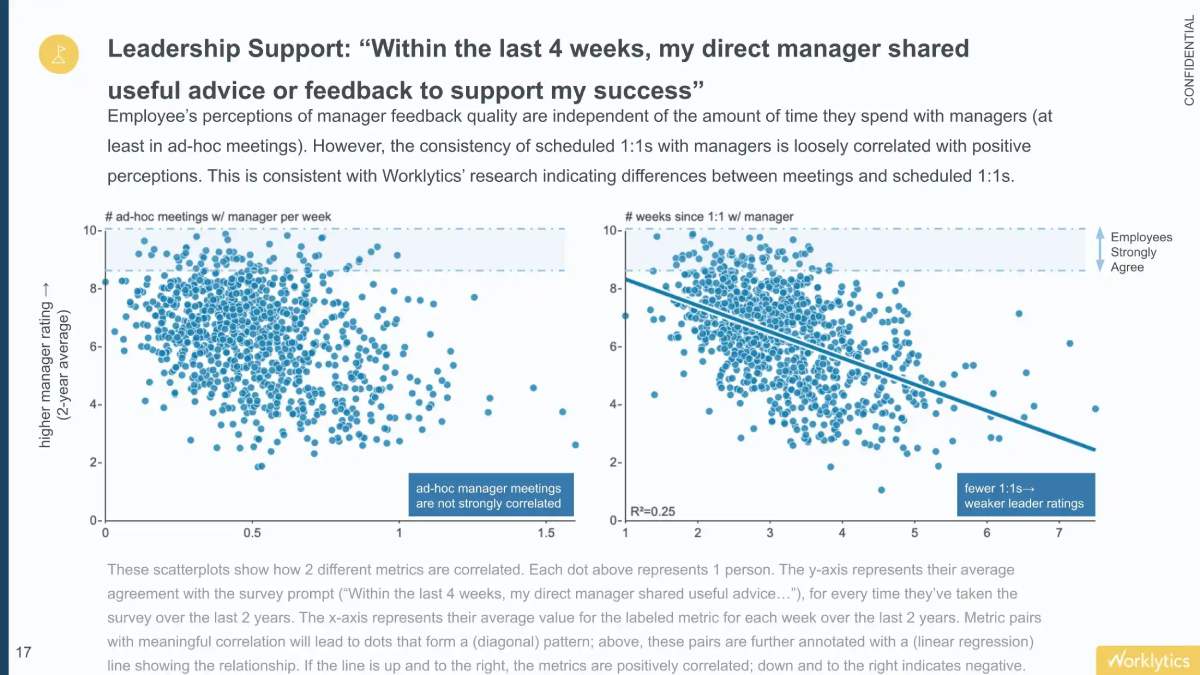
Worklytics produces both reports directly from data your team already generates. The point of mentioning it here is not that you need a tool. The point is that the analysis step is where most feedback loops break, and closing that gap is what separates teams that improve from teams that meet about improving. For a more complete framework, our guide on how to measure and improve engineering productivity walks through the full metric set we use in practice.
Most teams underinvest in the two phases that bookend an engineer's tenure: the first 90 days and the path to the next level. Both directly affect retention, which is the single largest hidden cost in engineering.
Most startups treat career ladders as a late-stage HR artifact. That is backwards. A documented ladder, even a simple one, signals to candidates that you have thought about their future. It is especially important for underrepresented candidates evaluating whether they will be supported.
Start with three levels (engineer, senior engineer, staff engineer) and a parallel management track (engineering manager, senior manager). Add levels as the team grows. The point is not perfection. The point is clarity about what good looks like at each stage.
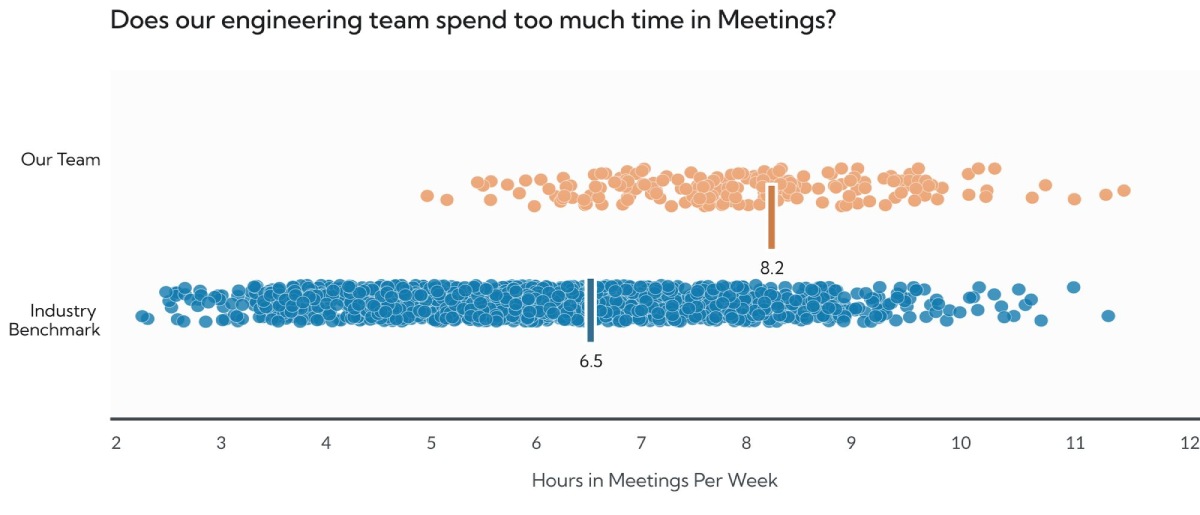
Meetings are necessary, but they are a major source of inefficiency when not tightly controlled. Every hour in a meeting is an hour not spent in deep work, and meetings fragment schedules, which makes the remaining time harder to use.
A useful diagnostic for the quarterly audit: pull every recurring meeting with more than 8 attendees where fewer than 3 people speak. That list is usually 20 to 30 percent of a team's recurring meetings and a clean cut list. For a more structured approach, our calendar analytics playbook walks through how teams reclaim up to 8 focus hours per week by systematically auditing meeting load.
Managers shape execution by setting clarity, removing blockers, and protecting team focus. A weak manager can cap a strong team's output. A strong manager can compound the output of an average one.
Manager performance is hard to assess because the usual signals are subjective and lagging: engagement surveys, attrition, the occasional skip-level. By the time those tell you something is wrong, the damage is done.
The best leading indicators are team-level, not individual-level. Look at the team a manager runs and ask: Is review wait time stable or growing? Is workload distributed evenly, or concentrated on two engineers? Is after-hours activity normal for your culture, or trending up? These signals point at the system the manager owns, not the manager's behavior. That distinction matters for trust on the team and for the validity of the data. For a deeper framework, our playbook on measuring manager effectiveness without surveys outlines the specific KPIs that work in modern hybrid teams.
High performance must be sustainable. If output depends on heroics, quality and velocity will degrade, and the best engineers will leave first.
Three patterns tend to predict burnout before engineers self-report it: a sustained increase in after-hours activity over a 4 to 6 week window, meeting load above 15 hours per week on engineers who should be building, and high work fragmentation (lots of short, interrupted focus blocks instead of multi-hour stretches). Any modern engineering analytics platform can surface these from calendar and tool data. The intervention is straightforward once you see the pattern: redistribute workload, cut meetings, or both. If burnout prevention is a priority for your org, our burnout and wellbeing solution is built specifically around these leading indicators.
Focusing only on hiring and ignoring system design. Without strong structure, ownership, and workflows, even excellent engineers underperform. The reverse is also true: a well-designed system makes average engineers look great.
A senior full-stack engineer in most cases. They set technical standards, build the initial architecture, and help interview the next four hires. Hiring junior engineers first only works if the founder is technically strong enough to act as tech lead, and even then it slows everything down.
Measure collaboration patterns and dependency chains. If certain teams or individuals are constantly pulled into other teams' work, ownership is unclear. Hidden bottlenecks always show up in collaboration data before they show up in delivery metrics.
Optimize the environment, not the individual. Use data on workflows, meeting load, and collaboration patterns to remove friction, instead of tracking output per person.
AI coding assistants meaningfully shift productivity, but only when adoption is consistent across the team. Measure usage and standardize the practices of high-leverage adopters so the gains do not stay isolated to a few engineers. Our analysis of whether AI tools are actually improving collaboration digs into the data and where the real productivity gains come from.
Run continuous feedback loops on delivery metrics, and monitor well-being indicators like after-hours work and meeting load. Performance degrades quietly long before it shows up in shipped output.
Learning how to build an engineering team requires holding two ideas at the same time. You need the foundational work: hiring the right roles in the right order, choosing a structure that fits your stage, and standing up the basics like onboarding and career paths. You also need the systems work: designing the operating environment so the team you built can actually perform.
Most articles cover only the first half. Most teams that struggle are missing the second. By focusing on structured hiring, scalable team design, disciplined execution, and visibility into how your team actually operates, you create an environment where high performance becomes the default outcome rather than the exception.
If you are past 15 to 20 engineers and the gap between your org chart and how work actually flows is starting to cost you, that is the moment to add behavioral analytics to your toolkit. Worklytics for Engineering Effectiveness is built for exactly this stage. The earlier you close the visibility gap, the less expensive the structural mistakes you avoid.
ong team is how you set yourself up for success. Great teams are the foundation of a successful company. Like small independent startups, they drive innovation from inside. They are productive, challenging and fun to work in. Their energy is contagious and spreads through a company. These are the teams that develop amazing products and services. They are the teams that get things done.
Creating great teams is challenging. They need a magic combination of the right people, environment and goals. That said, there are certain traits that many of the best teams share. By promoting these, you lay the ground for them to develop.
Great teams communicate well. They keep people informed with the least amount of effort. Team members understand what they need to do and buy in to why they are doing it. These teams create open, safe environments where people feel comfortable sharing ideas and concerns. When it comes to dealing with problems they also differ. People are upfront about their feelings and quick to deal with issues. Great teams don't waste time with unnecessary communication and meetings. They seek efficient ways to communicate and keep discussions focused.
Encouraging healthy communication in teams comes down to effective process, tools and leadership. Are leads setting a good example by communicating well themselves? Explaining what and why things need to be done. Do they communicate in a compelling fashion? Are they focused on developing great communication channels and ensuring they work? Productive, open weekly meetings, regular product presentations, peer reviews etc. Is there clear process in place to encourage regular communication? Are you providing teams with the right tools to facilitate this?
A strong culture is another common characteristic of great teams. They often develop their own rituals, nicknames, and terms. This binds them closer together and makes them more effective as a group. It also makes coming to work more fun and boosts morale as a result.
Paying attention to how people work together and mixing the right profiles can help.
A great team culture is not something you can force. It develops over time and only in the right environment. That said, it is largely driven by the mix of members and leads on a team. Paying attention to how people work together and mixing the right profiles can help. Picking the right team lead and coaching them to think about culture is critical.
A good sign of a strong culture is when teams spend time outside of the office together. Although this again is not something you can force, there are ways to promote it. Things like Friday evening pizzas and beer, team-building events and discretionary team budgets are some examples. It should be responsibility of a team lead promote this kind of activity.
Having a set of clear and achievable goals is critical for any team. Before focusing on anything else, ensure that everyone knows what they are aiming for and why. Without this they will lose their way and become demotivated.
Great teams avoid heavy top-down structure, where only managers care about goals.
Beyond just having goals, great teams promote a sense of shared responsibility. Everyone on a team feels bought in to the team's shared mission. If the team succeeds, it's everyone's win. If they don't, they band together to find a way forward. They avoid heavy top-down structure, where only managers care about goals. They also know that each team member plays a different role in achieving the team's goals.
Having teams set and defend their own goals is a good way to encourage this form of accountability. Ensuring team members all share in rewards for success is also key. Leads should be responsible for ensuring that everyone understand and buys in to goals. Answering doubts and keeping the team focused.
While they share common goals, people on great teams have well defined individual responsibilities. They trust one another to each play a part in getting things done. They hold each other accountable for delivering on promises. This clear definition of roles also spans to leadership. They know who is ultimately responsible for technical, design or product decisions.
Communicating responsibilities in writing and to everyone, is an easy way to set a team up for success.
Ensuring clear definition of responsibilities is an important part of building a healthy team. It allows people to focus on their work and trust that others will do theirs. It also avoids the misunderstanding and frustration that poorly defined roles can lead to. This is particularly true when leadership is not well defined. Decisions take much longer, outcomes are unclear and people get frustrated. Communicating responsibilities in writing and to everyone, is an easy way to set a team up for success.
Teams facing too many internal obstacles struggle to succeed. Great teams need freedom to experiment and find their way. They need the space to develop their own internal process and culture. Too much top-down company control can make this difficult.
Strong teams also often work as self-contained units. Team members collectively share most of the skills they need to build their products. This means they can get work done without constantly depending on external resources. This independence allows them to move quickly and remain focused.
It's important to consider whether your company is making it difficult for great teams to form.
It's important to consider whether your company is making it difficult for strong teams to form. Do you have unnecessary process that slows them down? Is there too much control on what tools and process they use? Is too much top-down approval preventing them from making decisions? Do they have easy access to all the resources they need to get things done quickly? Are teams heavily coupled and dependant on one other?
It's a good idea to run regular reviews of how teams in your company are working. Asking people about their experiences working in their team is a good way to do this. This can be done either formally, with team reviews, or more informally by just chatting to people. It is also useful to look for examples of teams that are running well. Analyze what they are doing that's different and try to apply this elsewhere.
Most of all, ensure that you are taking the time to iterate on how teams form and develop in your company. Don't forget that if you want to build an awesome product, you're going to need a great team. Interested in learning more? Check out our sample Engineering Effectiveness report