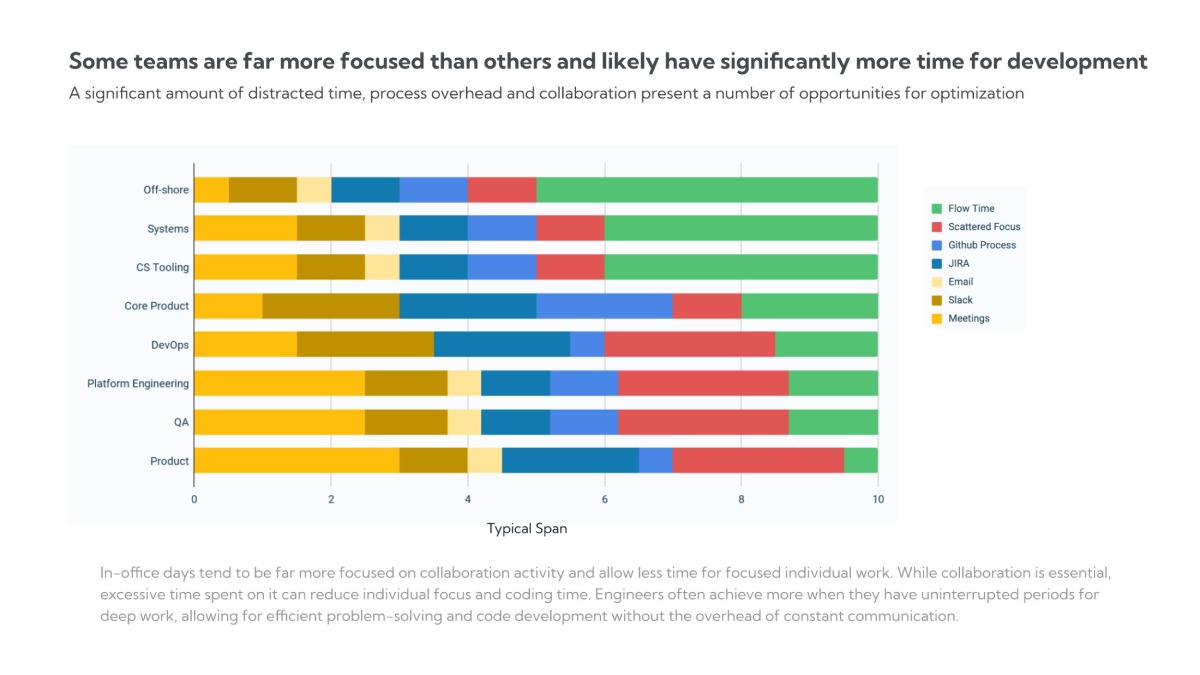

Employee monitoring is now close to universal. By most estimates, around 96% of companies use some form of activity tracking, usually justified as a way to boost productivity and keep people accountable. The assumption underneath that number is that watching employees more closely makes them work better.
The evidence does not support it. Research consistently finds that invasive monitoring erodes trust, raises stress, lowers engagement, and in many cases reduces the very productivity it was meant to protect. One survey found that 43% of employees feel monitoring violates their trust rather than improving their performance. Other studies have found that workers given autonomy and outcome-based goals are 35 to 40% more productive than those tracked minute by minute.
This article lays out 10 evidence-based reasons to reconsider invasive monitoring, takes the "but it boosts productivity" claim head-on, and ends with a privacy-first alternative that gives leaders the visibility they actually need without the damage.
Employee monitoring software, sometimes called employee surveillance software, is a broad category of tools built to track user activity on work devices. At the invasive end, these tools record nearly every digital action an employee takes.
Common surveillance tactics include:
These tools can produce data that looks like a measure of engagement, but they mostly capture superficial metrics that do not reflect the quality or output of the work. And the invasive nature of keystroke and mouse tracking tends to breed exactly the mistrust that damages morale and culture. The 10 reasons below go through why, one at a time.
Using activity monitoring as a proxy for productivity is fundamentally flawed. Systems built to track keystrokes, clicks, and active time fail to capture the quality or value of what gets produced. While productivity tracking tools and productivity dashboards can offer surface-level data, those metrics do not reliably correlate with outcomes. One employee may stay "active" all day on low-value tasks while another delivers high-quality work in half the time. Measuring motion instead of results misleads management and overlooks the creative thinking that actually drives a company forward.
One of the most immediate effects of remote monitoring software is the erosion of trust between management and staff. When employees know their activity is being watched, it creates a culture of suspicion. That environment leads to disengagement, because people feel they are under constant scrutiny and are not trusted to manage their own time. There is also a counterintuitive finding worth noting: at least one study found that monitored employees became more likely to break rules, not less, which researchers attribute to the breakdown of trust that monitoring signals.
People do their best work when they have autonomy. Constant oversight undermines that, and the result is lower engagement. Monitored employees tend to operate in "safe mode," doing only what is necessary to satisfy tracked benchmarks. Over time that erodes creative problem-solving, initiative, and the willingness to collaborate, all of which matter far more to organizational growth than a full activity log.
Invasive monitoring raises real legal and ethical questions. Privacy laws vary by jurisdiction, and companies that monitor without complying can face genuine legal difficulty. Frameworks such as GDPR and CCPA contain specific language designed to protect employees from invasive monitoring, and several US states now require explicit notification. Beyond the law, there is the ethical question of how far an employer should reach into an employee's working and personal life. Companies have to balance performance management against individual privacy, and invasive tools put a thumb hard on the wrong side of that scale.
Monitoring tools can quietly reshape a company's culture, shifting it from trust to surveillance. Even when the intent is efficiency or accountability, constant oversight tends to produce a few predictable effects:
Over time this produces a transactional culture, where people prioritize hitting measurable targets over doing meaningful, high-quality work. Creativity narrows, collaboration turns cautious, and team energy fades.
This is the irony at the center of the whole practice. Companies install productivity tracking software to lift output, and often get the opposite. Constant monitoring replaces a culture of trust with one of control, and as autonomy shrinks, so does intrinsic motivation.
Instead of focusing on meaningful work, employees redirect energy toward looking busy and satisfying the metrics. That reactive mindset slows problem-solving and discourages initiative. The ongoing stress of being watched adds mental fatigue and anxiety, which feeds burnout. The cumulative result is less engagement, less innovation, and a decline in the exact output the monitoring was supposed to protect.
High employee turnover usually points to deeper problems, and activity tracking can make those problems worse. When people feel undervalued and constantly surveilled, they are more likely to look elsewhere. The organization then absorbs the cost of recruiting and training replacements, which quietly eats into the bottom line the monitoring was meant to help.
Monitoring puts up barriers to open communication. When employees know their activity is under constant review, they hesitate to raise concerns or float half-formed ideas, and that hesitation slows collaboration across the team. Organizations are better served by building transparent communication channels than by relying on surveillance to fill the gap.
One of the biggest weaknesses of activity tracking is how easily it is gamed. Employees can use tools that fake mouse movement or automate keystrokes to simulate engagement. Others cycle between applications or generate filler reports to look productive. The behavior wastes time and feeds management inaccurate data, which leads to misguided performance assessments and decisions that never touch the real issues affecting the team.
Monitoring can give leadership the comfortable feeling that risk is handled when it is not. A full activity log looks like oversight, but it does not stop a determined insider, it does not prevent the data leaks that matter most, and it does not tell you whether work is actually getting done well. Worse, it can pull attention and budget away from the things that genuinely reduce risk, such as access controls, clear policies, and a culture where people feel safe reporting problems. Monitoring everything is not the same as protecting anything, and treating it as if it were leaves real gaps unaddressed.
This is the strongest argument monitoring vendors make, and it deserves a direct answer rather than avoidance. There is real research behind the claim. Some studies have found a productivity bump of around 7% when employees know they are being monitored, and one older American Management Association study reported an average increase of 22% among organizations that adopted monitoring.
The problem is what those numbers actually measure. Most of the effect is the Hawthorne effect: people change their behavior in the short term simply because they know they are being observed. It is a reactivity artifact, not a durable gain. The bump tends to fade as monitoring becomes routine, and what is left behind is the stress, the disengagement, and the gaming behavior described above.
It also matters what is being counted. A 7% rise in "active time" is not a 7% rise in value delivered. Activity and output are different things, and the studies that show monitoring gains are usually measuring the former. When researchers measure actual outcomes, the autonomy-based approach tends to win: recall the finding that employees with outcome-based goals are 35 to 40% more productive than those tracked minute by minute. So the honest answer is that monitoring can produce a short-term, surface-level bump in activity metrics, at the cost of the trust and engagement that drive long-term performance. That is a bad trade.
Avoiding invasive monitoring does not mean flying blind. The choice is not between surveillance and no data. It is between two different ways of getting visibility into how work happens.
The alternative to surveillance is not ignorance. It is changing the unit of analysis. Instead of watching individuals, privacy-first workplace analytics looks at corporate data at the group level to give leaders a holistic view of workflows and processes without intruding on any one person's privacy.
Rather than spending energy on activity metrics that may not reflect real productivity, leaders can focus on identifying and removing the barriers and bottlenecks inside workflows. That shift, from scrutinizing individual performance to understanding collective processes, is what actually makes teams more effective.
Workplace analytics gives managers a clear picture of team dynamics: how tasks connect, where work stalls, and where a process change would help. It moves the focus away from individual performance metrics, which are easy to misread and easy to game, and toward the collective patterns that genuinely drive output.
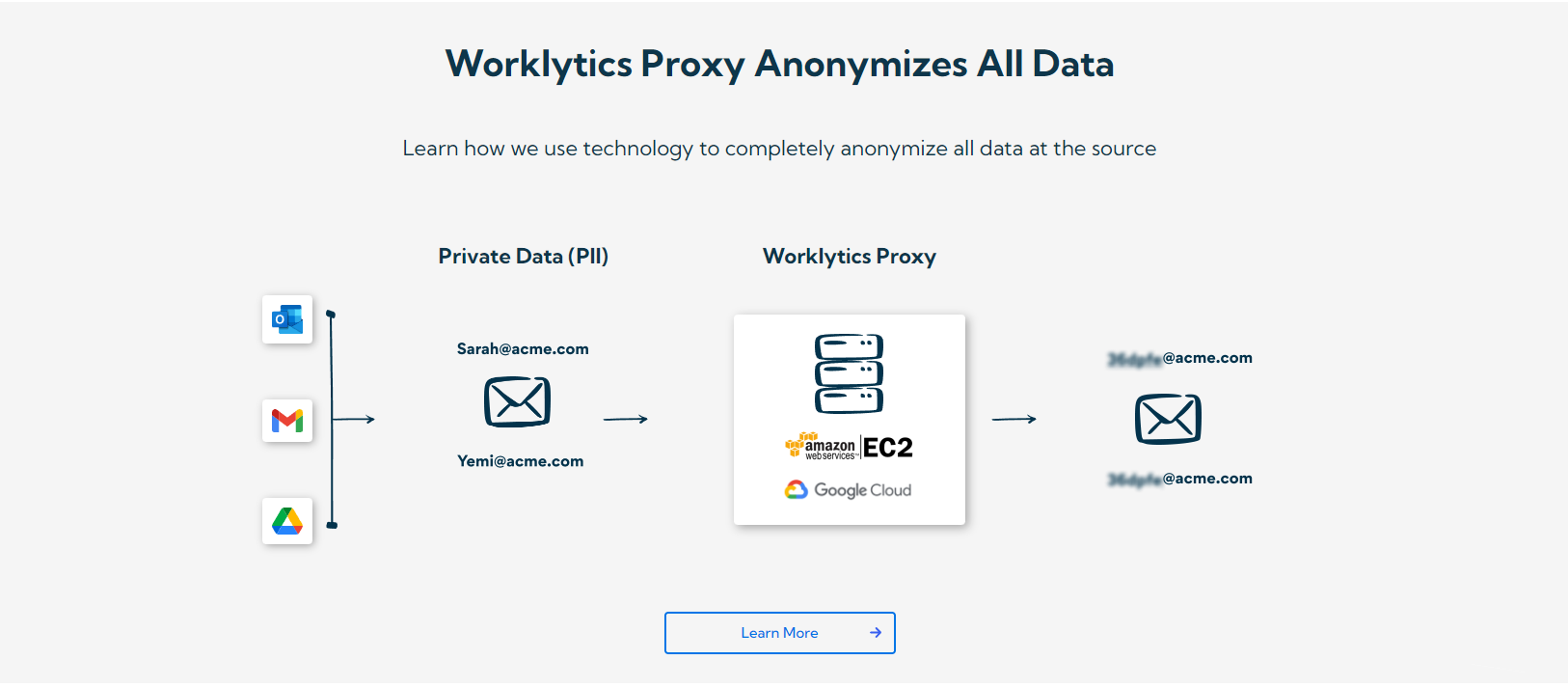
De-identifying corporate productivity data and aggregating it to the group level is the core of protecting employee privacy while still getting useful insight. Aggregation means no individual contribution is singled out, which builds the trust and openness that invasive monitoring destroys. Leaders can still assess group workflows, but employees do not feel watched.
When privacy is protected, people engage more freely and share ideas more willingly, because their autonomy is respected. That environment supports the innovation and collaboration that lift productivity for real, instead of on a dashboard.
Note for the dev team: wrap this section in FAQPage schema. Each H3 is a Question, the paragraph below is the Answer.
Monitoring employees' social media intrudes on personal privacy and undermines workplace trust. It tends to damage morale and signals a culture of surveillance rather than respect. Most of what an employer needs, around conduct and security, can be handled through clear policy and access controls rather than watching personal accounts.
It can produce a short-term bump in activity metrics, largely through the Hawthorne effect, where people change behavior because they know they are watched. That gain usually fades, and it measures activity rather than real output. Over time, monitoring tends to increase stress and reduce trust and engagement, which lowers genuine performance. Approaches built on autonomy and outcome-based goals consistently outperform minute-by-minute tracking.
Invasive, individual-level surveillance software is generally not a good idea. There are better alternatives that build transparency and use analytics focused on collaboration patterns and wellbeing rather than surveillance. The goal should be understanding how work flows, not watching individuals.
The main disadvantages are eroded trust, reduced engagement, legal and privacy exposure, damaged culture, higher turnover, impaired communication, easily gamed data, a false sense of security, and, frequently, lower real productivity. In most cases the costs outweigh the surface-level visibility monitoring provides.
Companies can use privacy-first workplace analytics that work at the group level rather than the individual level. By analyzing aggregated, de-identified collaboration data, leaders can find workflow bottlenecks and process problems without surveilling anyone. Pairing that with clear policies and access controls covers the security need without the cultural damage.
Invasive employee monitoring promises accountability and tends to deliver mistrust, disengagement, turnover, and a false sense of security. The short-term productivity bump it can show is mostly an observation artifact, paid for with the trust that drives real performance.
Leaders do need visibility. They just need the right kind. Privacy-first workplace analytics gives you a clear view of how work actually flows, where it stalls, and what to fix, without surveilling a single employee. If you want to see what that looks like in practice, you can explore Worklytics' workplace analytics or read more about our approach to privacy.