Google deprecation has restricted Work Insights access to Enterprise Plus license holders only, leaving organizations without critical productivity analytics. The platform's 60-day data retention limit and license-dependent availability force companies to seek alternatives that offer comprehensive workplace analytics with privacy-preserving aggregation and cross-platform integration capabilities beyond Google's native constraints.
•
• Worklytics provides 400+ metrics across 25+ platform integrations while maintaining privacy through aggregated team-level insights
• Alternative platforms range from SMB-focused monitoring tools to Microsoft-centric solutions, each with distinct limitations
• Organizations losing Google analytics access need immediate replacement to prevent compliance risks and productivity blind spots
When Google Workspace admins face uncertainty as Work Insights access remains limited to Enterprise Plus licenses, thousands are searching for Google Workspace Insights alternatives. This post explains what's changing and compares three proven productivity analytics tools you can deploy to maintain visibility into your organization's productivity.
Work Insights is a reporting tool designed to help organizations track Google Workspace adoption and usage across their teams. However, the platform faces significant constraints in its availability and scope.
Work Insights is available only if your organization has Google Workspace Enterprise Plus licenses. If your organization no longer maintains any Enterprise Plus licenses, you'll lose access to Work Insights entirely. This creates a critical dependency that many organizations find restrictive, especially during license optimization efforts.
The platform's data retention presents another limitation--Work Insights keeps data for the current month and the previous month only, maintaining a maximum of 60 days. This narrow window makes trend analysis and long-term strategic planning nearly impossible.
"A Gartner Hype Cycle provides an objective map that helps you understand the real risks and opportunities of innovation." Without proper analytics tools, organizations risk missing critical insights about their productivity and collaboration patterns during a time when workplace dynamics are rapidly evolving.
The loss of analytics visibility leaves organizations without crucial metrics they've come to depend on for strategic decision-making, team optimization, and compliance reporting.
The absence of native analytics creates immediate operational challenges that extend far beyond simple reporting gaps.
Consider the scale of the problem: "The average executive spends 23 hours a week in meetings, nearly half of which could be cut without impacting productivity," yet without analytics, organizations lose visibility into these inefficiencies. This blind spot costs businesses billions annually in wasted time and resources.
Only 23% of digital workers are completely satisfied with their work applications in 2024, down from 30% in 2022. Without analytics to identify pain points and usage patterns, organizations cannot address these declining satisfaction rates effectively.
The research landscape reinforces this urgency. Meeting overload is the most pressing problem in hybrid work environments, yet without analytics, leaders cannot identify which teams suffer most or implement targeted interventions.
These gaps compound into strategic risks: inability to justify technology investments, missed opportunities for process improvement, and potential compliance violations from undocumented collaboration patterns.

Selecting the right analytics platform requires careful evaluation of several critical factors that determine both immediate effectiveness and long-term value.
Key evaluation criteria:
• Privacy architecture: Any personal identifiers within data should be stripped automatically when first ingested, with analyses provided only at the group/team level (minimum group size of 8)
• Cross-platform integration: Look for platforms that connect 25+ tools beyond just Google Workspace, enabling comprehensive organizational insights
• Compliance readiness: Ensure GDPR and CCPA compliance through proper data handling and retention policies
• Scalability: Consider whether the solution grows with your organization's needs
• Implementation speed: Evaluate deployment timelines--days versus months can significantly impact ROI
"86% of employees believe it should be a legal requirement for employers to disclose if they use monitoring tools." This statistic underscores the importance of choosing transparent, privacy-first solutions that build rather than erode trust.
Humanyze is SOC 2 Type 2 compliant, demonstrating one example of the security standards organizations should seek. However, compliance certifications represent just one aspect of a comprehensive evaluation framework.
The right platform balances powerful analytics capabilities with ethical data practices, ensuring insights drive improvement without compromising employee privacy or organizational values.
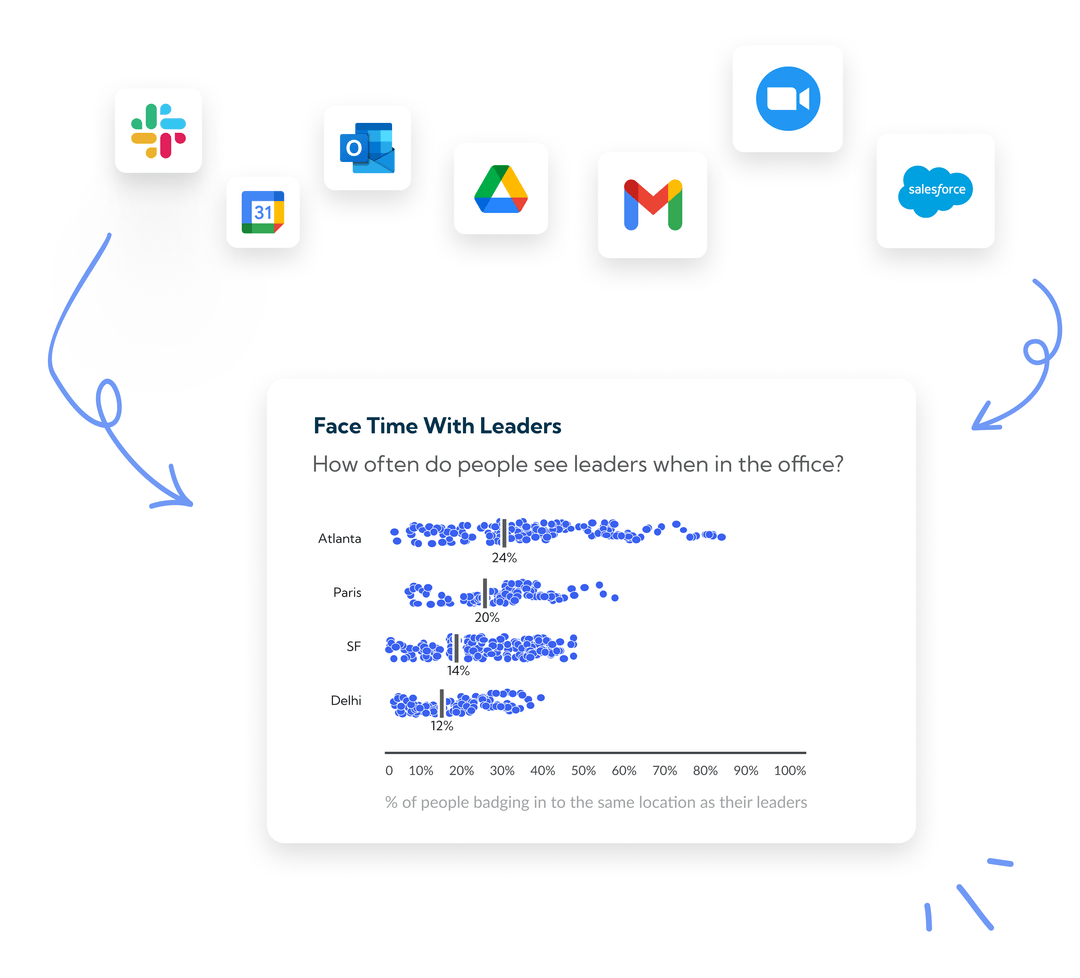
Worklytics gives you a clear, organization-wide view of how time is spent and work gets done, connecting data from tools like Slack, calendars, and email to reveal patterns, pinpoint inefficiencies, and highlight what's helping (or hindering) real progress.
The platform's privacy-first design sets it apart from competitors. "The average executive spends 23 hours a week in meetings, nearly half of which could be cut without impacting productivity," yet Worklytics addresses this without invasive monitoring. Worklytics integrates with Google Calendar data along with over 25 other tools in your tech stack, providing comprehensive visibility while maintaining privacy.
The platform's analytical depth exceeds basic usage metrics. "Worklytics processes and cleans data, generates and pushes over 400 metrics," enabling organizations to understand collaboration patterns, identify bottlenecks, and optimize team performance at scale.
Worklytics excels in several key areas:
•
•
•
•
These capabilities position Worklytics as the leading alternative for enterprises seeking robust, ethical productivity analytics.
This integration allows you to transfer your employee HR data from Google Workspace to Insightful, enriching the data with relevant fields including email, full name, job title, and status (inactive/active).
Insightful targets organizations prioritizing employee monitoring and time tracking over collaborative analytics. The platform emphasizes productivity monitoring through website and app usage tracking, helping teams identify which tools drive performance.
"In 2023, startups selling to enterprises saw their sales cycles increase by 36%, 2x the rate of those focused on SMB or mid-market customers." This distinction matters because Insightful's feature set and pricing model align more closely with SMB requirements than enterprise needs.
The platform offers several distinctive features:
•
•
•
"Many enterprise SaaS companies boast net retention rates (NRR) of 120-140%," yet Insightful's focus on core monitoring features may limit expansion opportunities within enterprise accounts.
Enterprise buyers have bigger budgets and higher ROI expectations, while SMBs are more price-sensitive. Insightful's straightforward pricing and feature set make it particularly attractive for SMBs seeking basic productivity monitoring without enterprise complexity.
Receive real-time attendance alerts so you can redeploy resources quickly and prevent productivity dips--a feature particularly valuable for smaller teams where each absence significantly impacts output.
Temporall's workplace analytics platform offers best-in-class Microsoft 365 Enterprise Reporting, delivering comprehensive, actionable insights for strategic decision-making for IT and business leaders.
The platform's Microsoft-centric design creates both strengths and limitations:
• Deep Microsoft 365 integration with granular usage visibility
• Drive efficient license allocation through continuous data analysis
• Copilot adoption tracking and ROI measurement
• "ISO 27001 Certified" and GDPR compliant
• Limited cross-platform analytics beyond Microsoft ecosystem
• Less comprehensive Google Workspace integration compared to alternatives
• Enterprise pricing may exceed SMB budgets
• Focus on Microsoft tools reduces relevance for Google-first organizations
Temporall suits organizations heavily invested in Microsoft 365 seeking detailed insights into that specific ecosystem. However, for companies using mixed technology stacks or prioritizing Google Workspace analytics, Worklytics offers superior cross-platform capabilities and deeper Google integration.
The platform's strength lies in Microsoft-specific metrics that other solutions cannot match, but this specialization becomes a weakness for organizations requiring broader visibility across diverse collaboration tools.
The deprecation of Google Workspace Insights creates an urgent need for alternative analytics solutions, but it also presents an opportunity to upgrade to more comprehensive platforms.
Worklytics gives you a clear, organization-wide view that extends far beyond what Google's native tools provided. With privacy-first design, 400+ metrics, and seamless integration across 25+ platforms, it addresses the full spectrum of enterprise analytics needs.
For organizations ready to transform their productivity analytics capabilities, the choice becomes clear. Worklytics processes and cleans data from your entire tech stack, delivering insights that drive real organizational improvement while maintaining the highest standards of employee privacy.
The path forward requires swift action but rewards organizations with deeper insights, better decision-making capabilities, and a foundation for sustainable productivity improvements. Choose a platform that not only replaces what you've lost but elevates your analytics capabilities for the challenges ahead.
Google Workspace Insights is now limited to organizations with Enterprise Plus licenses, restricting access and data retention to just 60 days, which impacts long-term strategic planning.
Without Google Workspace Insights, organizations lose critical analytics needed for strategic decision-making, team optimization, and compliance reporting, leading to potential inefficiencies and missed opportunities.
When selecting a productivity analytics platform, consider privacy architecture, cross-platform integration, compliance readiness, scalability, and implementation speed to ensure both immediate effectiveness and long-term value.
Worklytics offers a privacy-first design with comprehensive integration across 25+ platforms, generating over 400 metrics for deep organizational insights, making it a robust alternative to Google Workspace Insights.
Insightful is ideal for organizations focusing on employee monitoring and time tracking, offering features like location-based tracking and real-time alerts, which are particularly beneficial for SMBs.
Temporall provides deep integration with Microsoft 365, offering detailed insights and efficient license allocation, making it suitable for organizations heavily invested in the Microsoft ecosystem.
1. https://www.worklytics.co/integrations/gmail-analytics
2. https://support.google.com/workinsights/answer/9262638?hl=en-GB