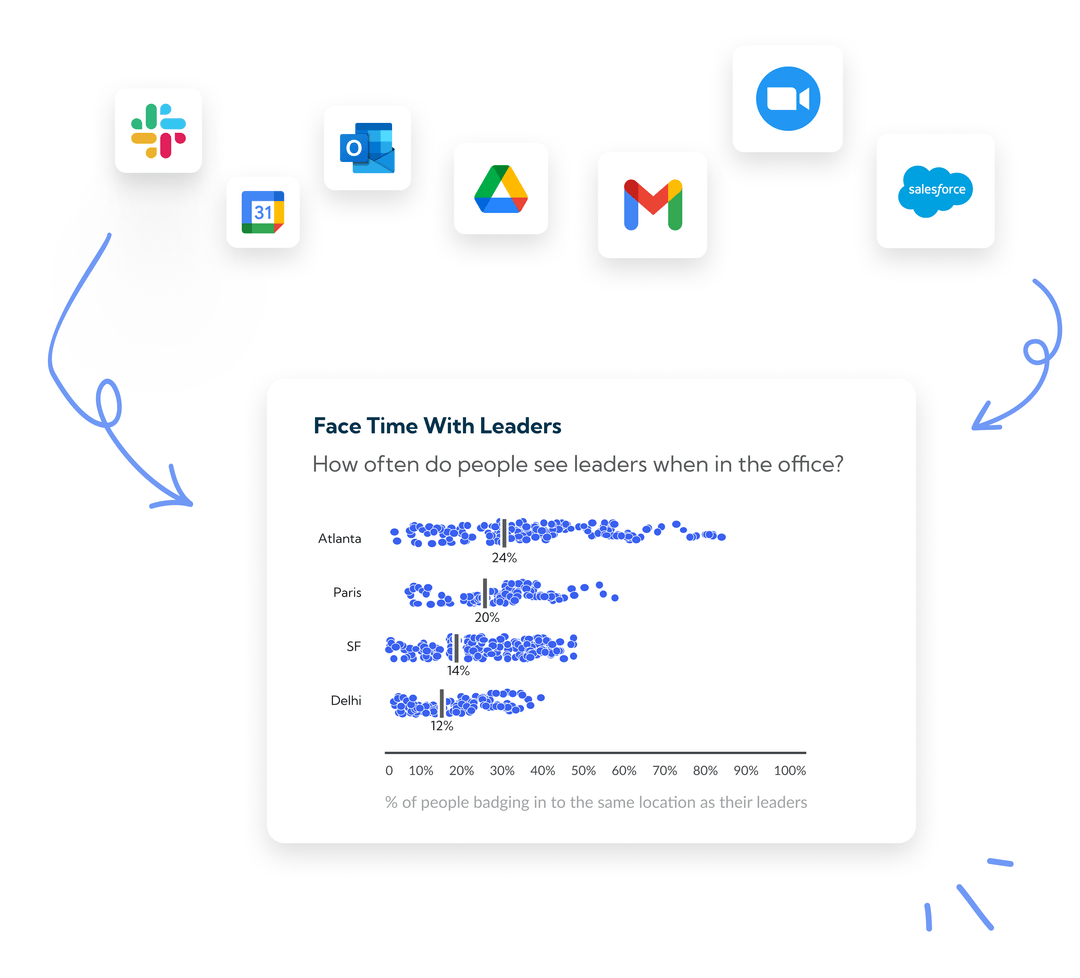
Employee productivity metrics enable organizations to measure actual work outcomes rather than just activity levels. Modern analytics platforms can track real-time collaboration patterns across digital tools while maintaining employee privacy through data anonymization. These systems reveal that executives spend 23 hours weekly in meetings, with nearly half being unnecessary, highlighting opportunities for significant efficiency gains.
• Privacy-first approach: Platforms use data anonymization and aggregation to comply with GDPR and CCPA while generating insights
• Comprehensive integration: Analytics tools connect with over 25 workplace applications including Slack, Office 365, and GitHub
• Meeting overload: 47% of employees identify excessive meetings as their biggest time waster
• Remote work scale: Over 58% of the workforce now works remotely, making digital productivity tracking essential
• Trust requirement: 86% of employees believe employers should legally disclose monitoring tool usage
Employee productivity metrics are no longer a nice-to-have; they are essential for navigating 2025's AI-driven workplace. With 36.2 million Americans expected to work from home by year's end and employees facing 275 interruptions daily, organizations need real-time visibility into how work actually gets done. Privacy-first analytics platforms now make it possible to track meaningful productivity indicators without compromising employee trust.
"How do you measure productivity? If your first instinct is to track hours worked, emails sent, or meetings attended—you're not alone. But here's the catch: none of these actually tell you whether real, meaningful work is getting done," as noted in recent Worklytics research.
True productivity encompasses three critical dimensions: efficiency (getting work done quickly with minimal waste), effectiveness (producing high-quality results that drive real impact), and sustainability (maintaining long-term performance without burnout). These elements have become even more crucial as 82% of leaders say 2025 is pivotal for rethinking strategy and operations amid AI integration.
The urgency is clear: "The average executive spends 23 hours a week in meetings, yet nearly half of those meetings could be cut without impacting productivity" (Worklytics). Meanwhile, 36.2 million Americans are expected to work remotely by year's end, making traditional oversight methods obsolete. Organizations that fail to adapt risk losing competitive advantage as productivity becomes the primary lever for growth in an increasingly digital economy.
Moving beyond hours logged requires focusing on outcome-based indicators that reveal actual value creation. Leading organizations now prioritize task completion rates for high-impact projects, revenue per employee as a business efficiency metric, and software utilization rates to ensure tool adoption.
Quantitative metrics provide the foundation, but qualitative indicators offer crucial context. Teams with at least 3.5 hours of daily focus time report significantly higher productivity. Yet employees face interruptions every 2 minutes on average, a metric that directly correlates with decreased output quality.
The most effective measurement frameworks balance leading indicators (like collaboration patterns) with lagging indicators (such as project completion rates). This dual approach enables proactive intervention before productivity issues become systemic problems.
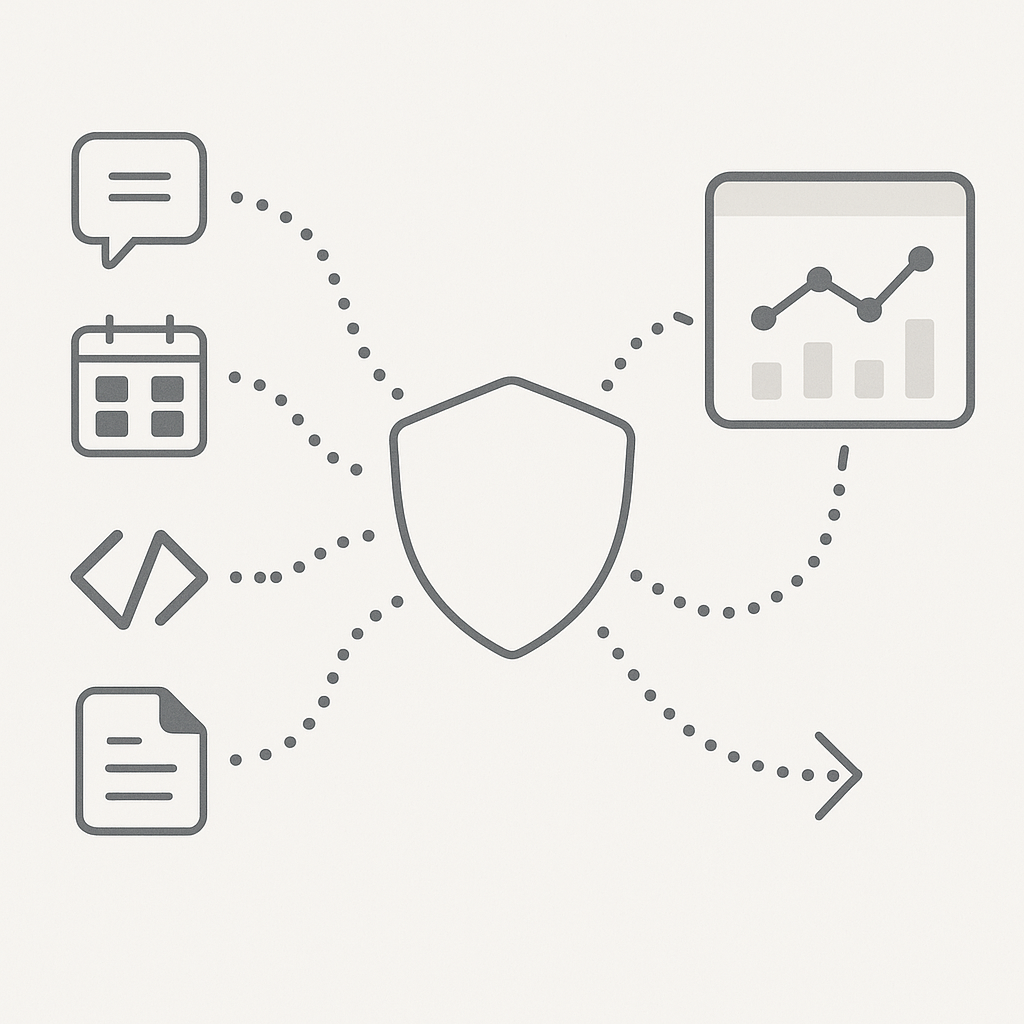
Modern productivity measurement leverages metadata from existing collaboration tools rather than invasive monitoring. Platforms aggregate transaction data from over 25 tools including email, calendar, and project management systems, transforming this raw information into actionable insights.
Real-time dashboards provide immediate visibility into workflow patterns, enabling rapid identification and removal of bottlenecks. These systems use Organizational Network Analysis to map informal communication networks, revealing collaboration efficiency without accessing message content.
The technology stack typically includes pre-built connectors for platforms like Slack, Google Workspace, and Office 365. Data flows through anonymization proxies before aggregation, ensuring individual privacy while delivering team-level insights.
Essential integrations span communication, project management, and development tools:
• Communication platforms: Slack, Microsoft Teams, email clients for message volume and response times
• Calendar systems: Office 365, G Suite for meeting load analysis
• Project tools: Jira, Asana for task completion tracking
• Code repositories: GitHub, GitLab for engineering productivity
• Document platforms: OneDrive, SharePoint for collaboration patterns
These connectors enable comprehensive productivity measurement across all work streams while maintaining data security through encrypted APIs.
Privacy concerns have intensified following high-profile enforcement actions. French regulators fined a company €40,000 for excessive surveillance through screenshot capturing and inactivity tracking. Italian authorities imposed €50,000 in penalties for unlawful employee geolocation during remote work.
These cases underscore a critical principle: productivity monitoring must balance organizational needs with employee rights. Systems that track keystrokes or capture screenshots violate GDPR's proportionality requirements. Instead, privacy-first platforms anonymize data at collection, aggregate metrics before analysis, and never store work content.
"Overtracking kills motivation – Employees who feel surveilled often spend more time gaming the system than doing actual work," according to productivity research. Successful implementations require transparency about what's measured, employee consultation before deployment, and clear policies limiting data use to aggregate analysis.
Raw metrics become valuable only when contextualized against industry standards and translated into actionable narratives. Productivity has jumped sixfold in median economies over the past 25 years, yet advanced economies could gain $1,500-$8,000 in per capita GDP by recapturing pre-2008 growth rates.
Effective benchmarking requires comparing similar roles across comparable organizations. Teams averaging 60/40 internal/external collaboration ratios typically outperform those with excessive external focus. Knowledge workers with 275 daily interruptions struggle to maintain deep work, a metric that directly predicts output quality.
Data storytelling transforms these comparisons into compelling change narratives. Rather than presenting utilization percentages, frame insights as opportunity costs: "Reducing meeting load by 20% would free 4.6 hours weekly for strategic work." This approach connects metrics to business outcomes, securing stakeholder buy-in for productivity initiatives.
Organizations choosing productivity analytics platforms face a fundamental decision between comprehensive cross-platform analysis and ecosystem-specific solutions. Worklytics integrates data from over 25 collaboration tools, while Microsoft Viva Insights provides deep integration within the Microsoft 365 environment.
Worklytics' privacy-first architecture analyzes collaboration patterns without accessing content, using machine learning to clean and standardize datasets across platforms. This approach enables Organizational Network Analysis that reveals cross-functional collaboration inefficiencies invisible within single ecosystems.
Microsoft Viva Insights excels at team-level dashboards for managers already invested in Microsoft infrastructure, though it may incur higher setup costs. Organizations using diverse collaboration tools or requiring vendor-agnostic analytics typically find Worklytics' comprehensive approach delivers faster time-to-insight with greater flexibility for future expansion.
Transforming productivity data into performance improvements requires systematic intervention strategies. Research shows 70% of team engagement variation falls within managers' control, making leadership capability the primary lever for productivity enhancement.
Successful interventions follow predictable patterns. Google's OKR framework focuses teams on outcomes rather than activity metrics. "Microsoft studied workplace analytics and found that many teams were spending too much time in meetings, reducing deep work time. By making meetings more structured, they improved overall productivity."
Actionable steps include:
• Protect focus time: Block calendar slots for deep work, declining non-critical meetings
• Streamline collaboration: Establish communication protocols reducing unnecessary interruptions
• Coach with data: Use productivity metrics in one-on-ones to identify individual blockers
• Test and iterate: Run time-boxed experiments, measuring impact on key metrics
Managers who combine quantitative insights with qualitative feedback create sustainable performance improvements while maintaining team morale.
Productivity measurement has evolved from time-tracking to sophisticated analysis of work patterns and outcomes. Real-time metrics enable rapid testing and learning, while privacy-first approaches ensure employee trust. Organizations that master this balance gain competitive advantage through improved resource allocation and employee satisfaction.
The path forward requires selecting appropriate metrics for your context, implementing privacy-compliant collection systems, and building data literacy across management layers. Worklytics' anonymization proxy architecture provides a proven framework for ethical productivity analytics, transforming collaboration metadata into strategic insights without compromising individual privacy.
As hybrid work becomes permanent and AI reshapes job roles, real-time productivity intelligence shifts from operational nice-to-have to strategic imperative. Organizations ready to embrace transparent, ethical productivity measurement will thrive in 2025's rapidly evolving workplace.
In 2025, organizations should focus on outcome-based indicators such as task completion rates, revenue per employee, and software utilization rates. These metrics provide insights into actual value creation and help identify areas for improvement.
Companies can ensure privacy by using platforms that anonymize data at collection, aggregate metrics before analysis, and avoid storing work content. Transparency about what's measured and employee consultation are also crucial for maintaining trust.
Essential tools for real-time productivity measurement include communication platforms like Slack and Microsoft Teams, calendar systems like Office 365, project management tools like Jira, and document platforms like OneDrive. These tools help track various productivity metrics while ensuring data security.
Worklytics offers comprehensive cross-platform analysis by integrating data from over 25 collaboration tools, while Microsoft Viva Insights provides deep integration within the Microsoft 365 environment. Worklytics is ideal for organizations using diverse tools, offering faster insights and greater flexibility.
Managers play a crucial role in improving team productivity by protecting focus time, streamlining collaboration, coaching with data, and running experiments to measure impact. Leadership capability is a primary lever for enhancing productivity.
1. https://worklytics.co/productivity
3. https://worklytics.co/how-it-works
4. https://www.worklytics.co/blog/worklytics-benchmarks-see-how-you-compare
5. https://hbr.org/2025/02/research-a-better-way-to-keep-tabs-on-your-remote-workforce
7. https://worklytics.co/ona-data-analytics-software-worklytics
9. https://www.dataguidance.com/news/france-cnil-fines-company-eu40000-excessive-monitoring
10. https://www.dataguidance.com/news/italy-idpa-fines-public-agency-eu50000-unlawful
11. https://www.mckinsey.com/mgi/our-research/investing-in-productivity-growth
12. https://news.microsoft.com/annual-work-trend-index-2025/
14. https://www.peerspot.com/products/comparisons/microsoft-viva-insights_vs_update-hr
15. https://www.gallup.com/workplace/348713/measuring-productivity-less-important-managing.aspx