Worklytics stands out for employee AI usage analytics with its privacy-first approach and granular team-level segmentation capabilities. The platform integrates with major AI tools including Microsoft 365 Copilot, GitHub Copilot, and ChatGPT, providing real-time visibility into adoption patterns while automatically anonymizing personal identifiers. Unlike alternatives that focus on general productivity or collaboration metrics, Worklytics specifically tracks light versus heavy AI usage by department and role.
• Current AI adoption landscape: 75% of knowledge workers regularly use AI tools, with 58% of employees actively leveraging platforms like ChatGPT and Copilot
• Key differentiator: Worklytics provides team-level segmentation that most analytics platforms miss, revealing adoption gaps between departments and roles
• Privacy architecture: All personal identifiers stripped automatically upon ingestion, with analysis only at group level (minimum 8 people)
• Alternative limitations: ActivTrak focuses on general productivity metrics, Time Is Ltd. tracks collaboration patterns, Polinode relies on surveys, and Optimly specializes only in conversational AI
• Business impact: 93% of leaders at high-AI-usage companies support four-day workweeks versus less than half at low-adoption organizations
• Integration scope: Worklytics connects to Microsoft 365 Copilot, Slack, GitHub Copilot, Zoom, Google Gemini, Salesforce Einstein GPT, and ChatGPT for comprehensive tracking
The surge of Copilot-style tools has transformed how organizations work, but most companies still struggle to see beyond surface-level adoption metrics. With 75% of global knowledge workers now using AI tools regularly and 58% of employees actively leveraging platforms like ChatGPT and Copilot, the challenge isn't whether teams are using AI—it's understanding which teams are actually benefiting and where ROI gaps exist.
Most analytics platforms provide company-wide adoption percentages, but miss the granular segmentation that reveals uneven adoption patterns between engineering and HR, or why managers in certain departments resist AI while their teams embrace it. This visibility gap costs organizations millions in underutilized licenses and missed productivity gains.
Organizations face a critical measurement challenge. While "AI adoption in companies surged to 72% in 2024 (up from 55% in 2023)," most companies lack visibility into granular usage patterns that actually drive value.
The stakes are significant. Companies with high AI usage show dramatically different operational dynamics, 93% of leaders at high-AI-usage companies are open to implementing four-day workweeks, compared to fewer than half of those with minimal AI integration. This isn't just about working less; it's about working fundamentally differently.
The 107% increase in AI tool usage since 2022 has created a new category of analytics requirements. Traditional productivity metrics miss critical nuances—like how AI users consistently have longer workdays (+8 minutes) but lower focus time (-27 minutes). Without granular segmentation at the team level, these patterns remain invisible, making it impossible to target training, adjust workflows, or prove ROI to stakeholders.
Effective AI adoption dashboards go beyond simple usage rates to reveal actionable patterns. The most critical metrics segment users based on actual behavior rather than assumptions.
The market urgency is clear: By 2027, 80% of enterprise workflows will be AI-augmented according to Gartner. Organizations without these granular metrics risk falling behind competitors who can optimize AI deployment at the team level.
Worklytics distinguishes itself through a privacy-by-design approach that provides granular team insights without compromising individual privacy. The platform specializes in aggregating work activity data to generate insights while maintaining strict anonymization protocols.
The platform effortlessly plugs into AI-powered apps and collaboration hubs teams already rely on, including Microsoft 365 Copilot, Slack, GitHub Copilot, Zoom, Google Gemini, Salesforce with Einstein GPT, and ChatGPT. This comprehensive integration creates a cohesive, real-time pulse of AI adoption across the organization.
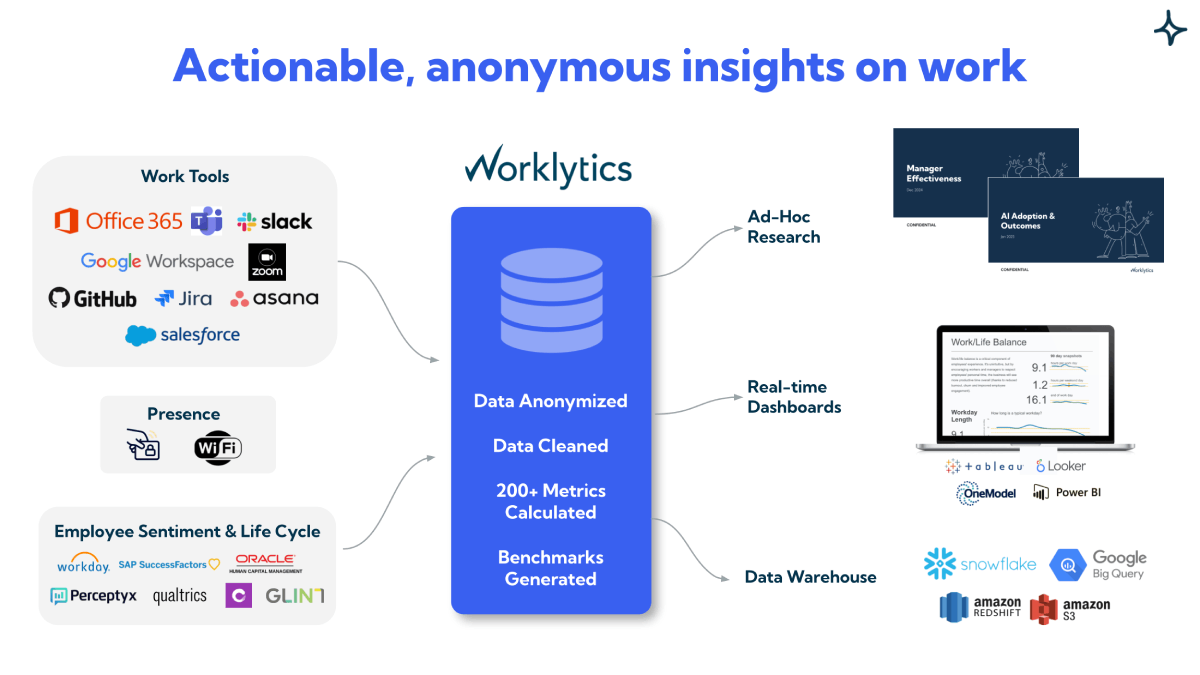
Any personal identifiers within the data are stripped automatically when first ingested, and analyses are provided only at the group or team level with a minimum group size of eight. This approach ensures meaningful insights while maintaining individual privacy—a critical balance as organizations navigate evolving data protection regulations.
Worklytics excels at revealing adoption patterns that other platforms miss. The system tells you where AI is flourishing, how it's being used (which tools, what frequency), and who your leaders and laggards are in the journey. This granular visibility enables targeted interventions rather than blanket training programs.
For security-conscious enterprises, Worklytics is audited annually against the AICPA SOC 2 standard by third parties. All data is encrypted before being written to disk using AES-256 bit encryption, providing enterprise-grade security alongside actionable analytics.
ActivTrak approaches AI analytics through a productivity-first lens, revealing interesting patterns but potentially missing AI-specific nuances. Their 2025 State of the Workplace report shows 58% of employees now using AI tools—a 107% increase from 2022—but their analysis focuses primarily on time-based metrics.
The platform excels at capturing broad workplace trends. ActivTrak data reveals that focus efficiency decreased to 62% while the average focused session shrunk 8%, suggesting AI adoption may fragment attention rather than enhance it. These insights are valuable but don't directly connect AI usage to business outcomes.
Where ActivTrak falls short is granular AI tool segmentation. While they track that workdays are 36 minutes shorter but 2% more productive, they don't break down which AI tools drive these gains or how adoption varies by department. This makes it difficult to optimize AI investments or identify which teams need different tools or training.
ActivTrak's strength lies in holistic productivity analysis, but organizations seeking deep AI adoption insights need platforms built specifically for that purpose.
Time Is Ltd. positions itself as the world's leading employee experience and engagement SaaS platform, focusing on collaboration analytics across meetings, instant messaging, emails, and applications.
The platform integrates with major tools including Google Workspace, Microsoft 365, Slack, Zoom, and Salesforce, extracting and analyzing communication patterns. However, their core competency centers on meeting effectiveness and collaboration efficiency rather than AI-specific metrics.
While Time Is Ltd. excels at identifying inefficiencies in communication patterns, they lack dedicated AI adoption tracking capabilities. The platform analyzes activity frequency at a company level while respecting individual confidentiality, but doesn't segment AI tool usage from general digital activity.
For organizations primarily concerned with collaboration optimization, Time Is Ltd. provides value. But companies needing to track AI adoption metrics, measure ROI on AI investments, or understand team-level AI usage patterns will find the platform's analytics too general for these specific needs.
Polinode specializes in organizational network analysis (ONA) through a combination of survey tools and passive data integrations. People Analytics teams can access built-in survey capabilities alongside integrations with major workplace productivity tools.
The platform's strength lies in network visualization and relationship mapping. Passive ONA utilizes digital communication data to understand informal organizational networks, with common data sources being email, calendar data, and enterprise social networks like Teams and Slack.
Starting at $20 per month, Polinode offers an affordable entry point for network analysis. However, the platform's survey-dependent approach creates limitations for real-time AI adoption tracking. While Polinode can map collaboration networks, it doesn't specifically track AI tool usage, adoption rates by department, or connect AI usage to productivity outcomes.
The platform's focus on combining active and passive ONA provides organizational insights, but misses the granular AI-specific metrics that drive adoption success. Teams looking for AI usage analytics would need to supplement Polinode with additional tools.
Optimly takes a different approach, positioning itself as the leading platform for chatbot analytics and AI-powered conversation intelligence. The platform integrates with your stack in minutes, focusing on conversational AI systems rather than broad workforce analytics.
The platform excels in its niche. Analytics revealed 40% of size-related questions for a specific product category at one client, leading to a size prediction AI tool that reduced returns by 60% and saved $280,000 quarterly. These targeted insights demonstrate Optimly's strength in customer-facing AI optimization.
However, Optimly's focus on conversational AI creates blind spots for enterprise-wide AI adoption. B2B SaaS marketing teams connect chatbot conversations to HubSpot, uncovering a 22% lift in pipeline from visitors who engaged with assistants. While valuable, this doesn't address internal AI tool adoption, employee usage patterns, or department-level analytics that organizations need for comprehensive AI strategy.
For companies prioritizing customer service or sales chatbot optimization, Optimly delivers specialized value. But organizations seeking full-workforce AI insights across tools like GitHub Copilot, Microsoft 365 Copilot, and internal AI platforms will find Optimly's scope too narrow.
Selecting an AI analytics platform requires matching organizational maturity with platform capabilities. The ServiceNow Enterprise AI Maturity Index reveals that less than 1% of organizations scored over 50 on their 100-point AI maturity scale, with average scores declining 9 points year-over-year. This suggests most organizations need foundational visibility before advanced analytics.
Start by assessing your current state. The IDC Future of Work Survey found over 69% of companies are investing in GenAI or evaluating its workforce impact. If you're in this evaluation phase, prioritize platforms offering broad integration capabilities and privacy-first approaches to build trust with employees.
Consider your integration requirements carefully. Worklytics bridges the gap with actionable, team-level insights showing not just where AI is being used but how effectively. This granular view becomes critical as organizations move beyond pilot programs to scaled deployment.
Key evaluation criteria should include:
Integration breadth: Can the platform connect to all your AI tools, from coding assistants to productivity suites?
Privacy architecture: Does the platform protect employee privacy while providing meaningful insights?
Segmentation depth: Can you analyze adoption by department, role, tenure, and usage intensity?
Real-time capabilities: Are insights available immediately or only through periodic reports?
Benchmark data: Can you compare your adoption against industry peers?
The right platform depends on your specific context. Organizations with strong privacy requirements benefit from Worklytics' anonymization approach. Companies focused on customer-facing AI might start with Optimly. Those prioritizing general productivity could begin with ActivTrak before adding specialized AI analytics.
The landscape of employee AI usage analytics has evolved beyond simple adoption metrics. Worklytics gives leaders a unified, real-time view of AI adoption that reveals not just usage rates but effectiveness patterns across teams.
While ActivTrak provides productivity context, Time Is Ltd. offers collaboration insights, Polinode enables network analysis, and Optimly optimizes conversational AI, only Worklytics delivers comprehensive team-level AI adoption analytics with privacy-first architecture. As organizations race to capture AI's value, those with granular visibility into team-level adoption patterns will optimize faster and achieve superior ROI.
The ability to track adoption and usage by team, tool, and role while maintaining employee privacy represents the new standard for AI analytics. Organizations that invest in these capabilities now will lead their industries as AI transforms from experimental technology to operational necessity.
For deeper insights into measuring AI adoption success, explore how to track the metrics that matter for your organization's AI journey.
Team-level visibility is crucial because it reveals uneven adoption patterns and helps identify which teams are benefiting from AI tools. This insight allows organizations to optimize AI investments and improve productivity by targeting specific teams for training and support.
An effective AI adoption dashboard should track metrics like light vs. heavy usage rates, AI adoption per department, manager usage, and the percentage of work activities with AI assistance. These metrics provide a comprehensive view of AI integration and its impact on productivity.
Worklytics employs a privacy-by-design approach, anonymizing data and providing insights only at the group or team level. This ensures individual privacy while delivering meaningful analytics, adhering to strict data protection regulations.
ActivTrak focuses on productivity metrics and may miss AI-specific nuances. While it provides valuable insights into workplace trends, it lacks granular AI tool segmentation, making it difficult to optimize AI investments or identify team-specific needs.
Worklytics offers comprehensive team-level AI adoption analytics with a privacy-first approach, unlike other platforms that may focus on productivity, collaboration, or conversational AI. It provides granular insights necessary for optimizing AI deployment across teams.