Walk into almost any office right now and you’ll notice it immediately: people are moving faster than ever.
Work that used to take half a day – drafting a proposal, analyzing a dataset, debugging code – is now done in minutes.
And at the individual level, the gains are undeniable.
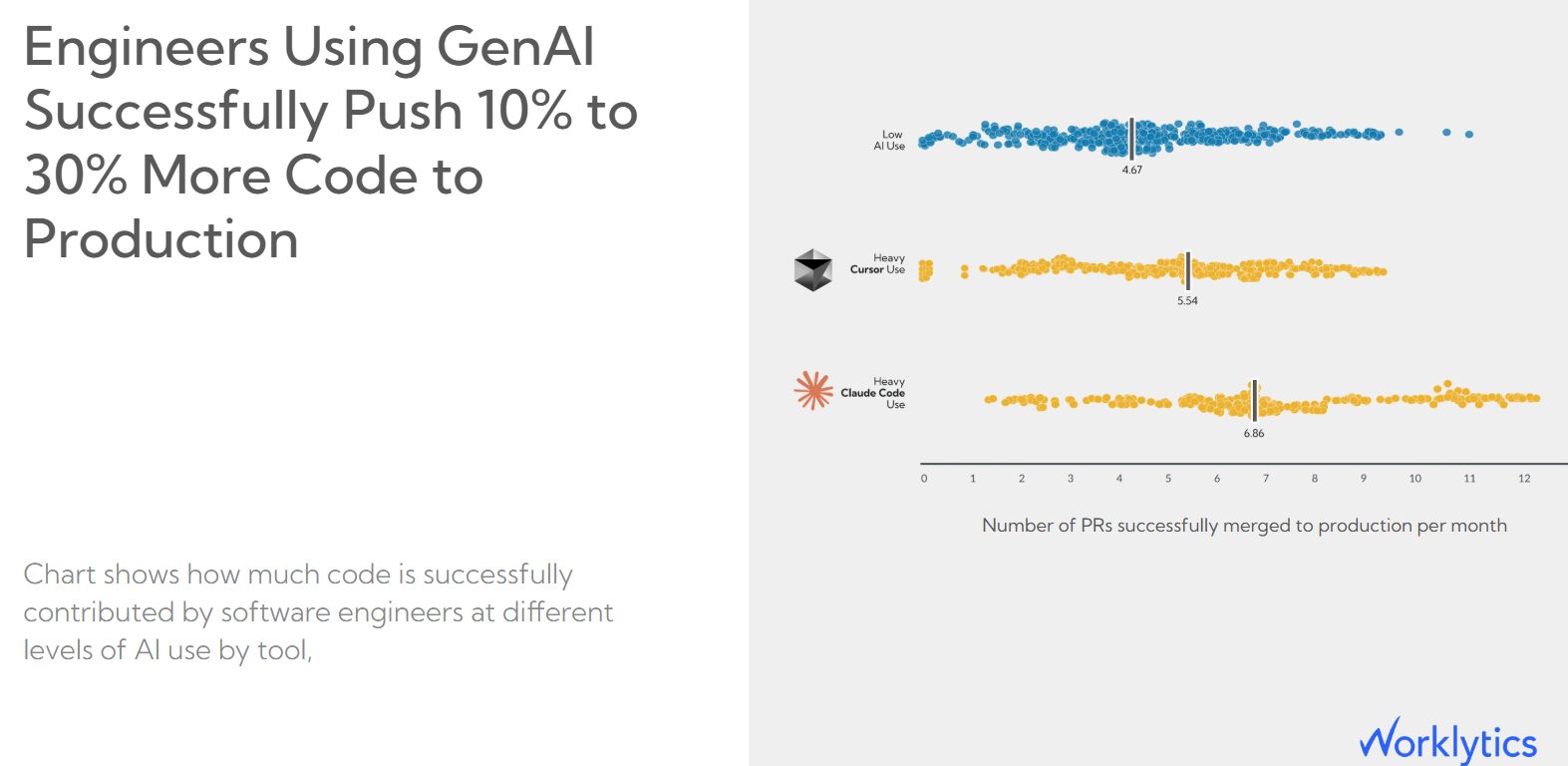
At Worklytics, we see it clearly in the data. Employees are writing more, analyzing more, and shipping more than ever before. The pace of individual contribution has fundamentally changed.
But zoom out and something doesn’t add up.
People are faster.
Output is higher.
So why aren’t companies moving faster too?
Let’s start with something that looks like an unequivocal win.
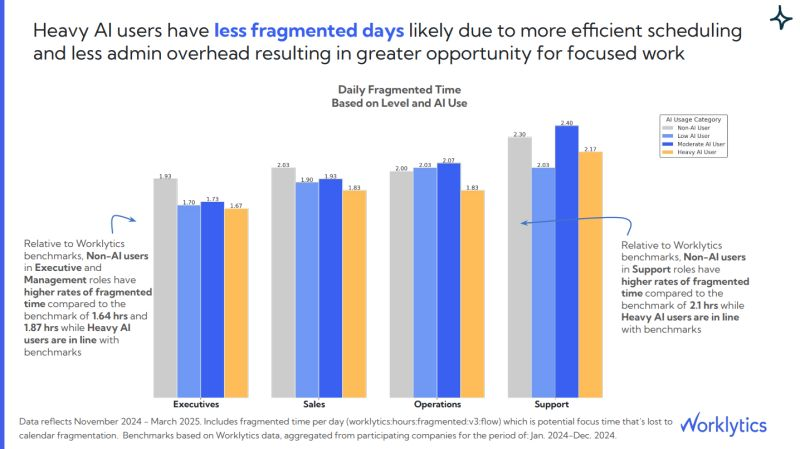
Heavy AI users tend to have significantly less fragmented days. They spend less time bouncing between tasks, less time on administrative overhead, and more time in focused, uninterrupted work.
The difference isn’t trivial.
In executive roles, non-AI users average about 1.93 hours of fragmented time per day. Heavy AI users reduce that by 13%.
That may not sound like much, but over six weeks, it adds up to gaining a full extra workday. Time that can be reinvested into higher-quality thinking, better decisions, or more meaningful work.
So on the surface, everything looks like it’s moving in the right direction.
More focus.
Less busywork.
Faster output.
But here’s the catch: these gains aren’t distributed evenly across an organization.
And that’s where the system starts to break down.
The most common assumption about AI in the workplace is that it’s a universal accelerator. If everyone works faster, the entire organization should move faster too.
But in reality, that’s not what happens.
Instead, we’re seeing AI dramatically improve how individuals work, but not automatically improve how work flows across teams.
And those are two very different things.
Let’s dig in.
AI tools are incredibly effective at helping individuals create.
You can draft documents faster. Generate ideas faster. Analyze information faster.
But most work inside a company doesn’t end with creation. It moves through a system of handoffs, reviews, approvals, iterations.
And those systems haven’t sped up at the same rate.
So what happens?
People start producing more work than ever before, but the rest of the organization can’t absorb it at the same pace. Instead of flowing smoothly, work begins to pile up at the next stage.
It’s like widening the on-ramp without expanding the highway. More cars get on faster, but congestion gets worse downstream.
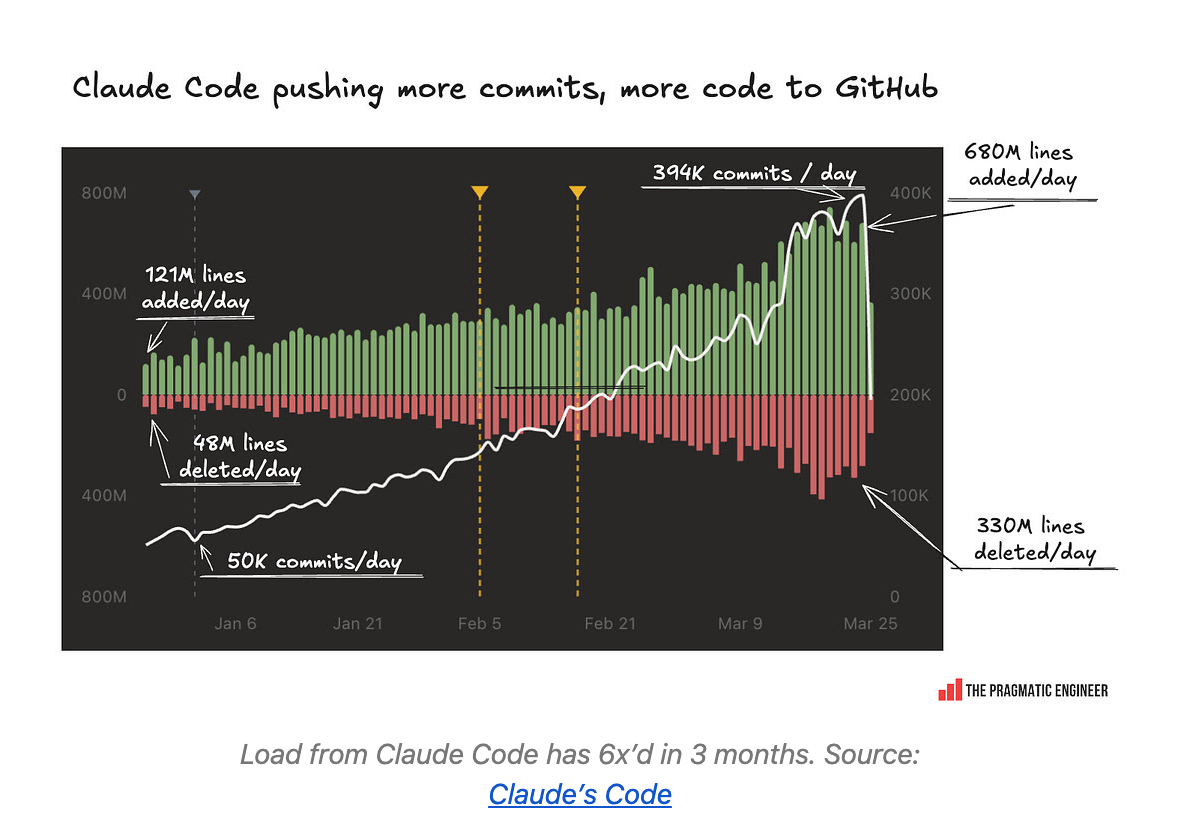
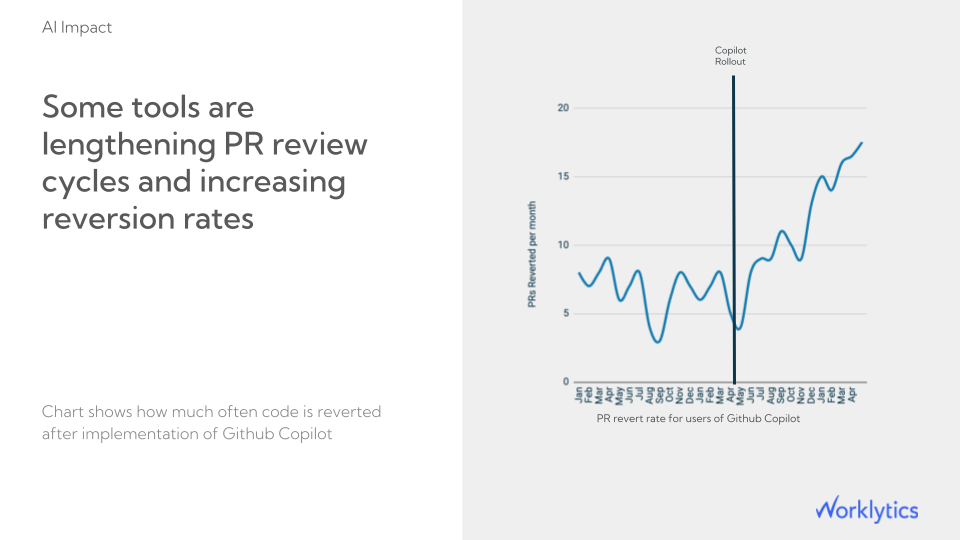
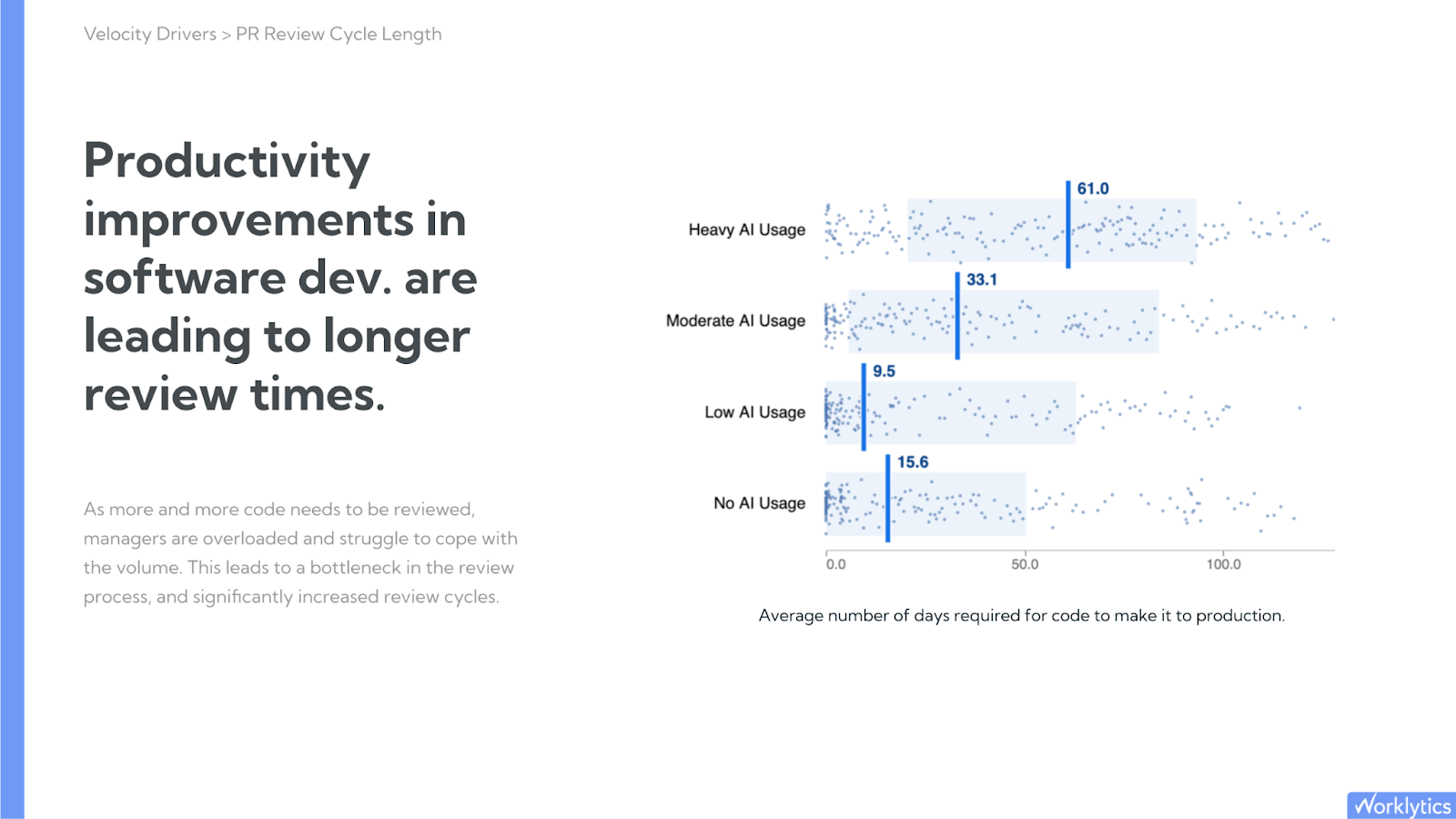
We’re seeing this play out clearly in software engineering. As engineers produce more code at lower cost, bottlenecks are forming at the review stage. Backlogs build as the people responsible for reviewing and signing off get overloaded.
From there, teams tend to fall into one of two patterns. Either reviews slow to a crawl, delaying releases, or they get rushed (and bugs slip through), creating even more work and slowdowns later on.
Before AI, creating “stuff” was often the bottleneck. Writing, researching, and building took time, which naturally limited how much work entered the system.
Now, creation is much faster.
But review, alignment, and decision-making? Not so much.
And this shift is colliding with another major change: delayering.
Many companies have spent the last few years flattening their orgs by removing layers of middle management to cut costs. Companies now have fewer managers with wider spans of control.
But then AI shows up and suddenly individual output spikes.
Now you’ve got fewer managers, each responsible for reviewing, aligning, and approving a much bigger stream of output.
It adds up quickly.
Middle managers are feeling the squeeze. They’re not just managing more people, they’re dealing with a surge in output from each person on their team.
There are more documents to review, more ideas to prioritize, more decisions to make.
The constraint didn’t go away; it simply moved downstream.
And in many cases, it moved to the exact places that are hardest to scale: human judgment, coordination, and alignment.
Another layer to this problem is uneven adoption.
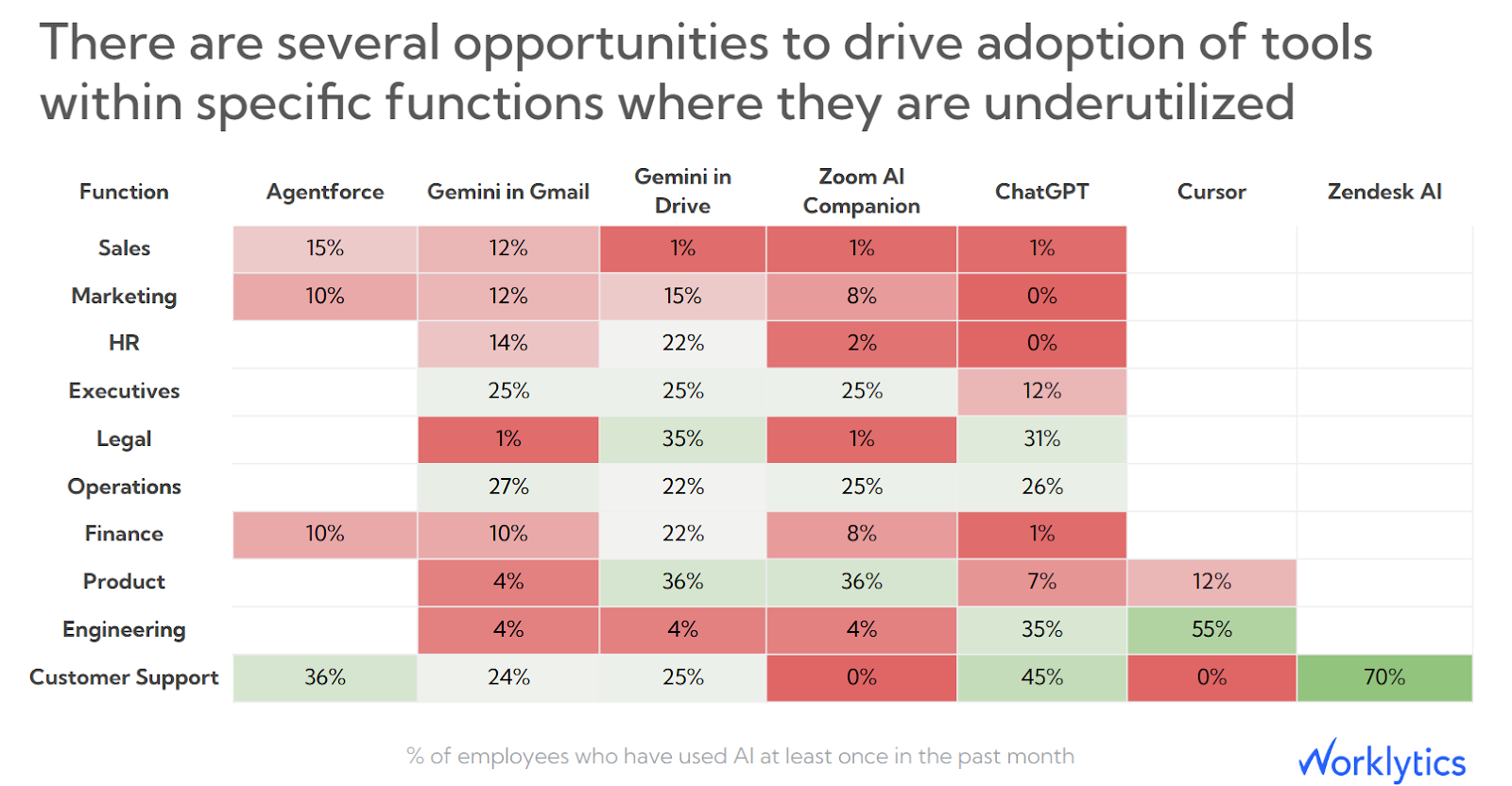
In most organizations, AI usage isn’t consistent. Some teams lean heavily into it and transform how they work. Others adopt slowly or not at all.
This creates a new kind of operational mismatch.
One team might be operating at “AI speed” where they’re moving quickly, producing more, iterating rapidly.
Another team might still be working in a more traditional way, with slower cycles and heavier manual processes.
When those teams interact, friction is inevitable.
Fast teams hit slow teams. Work stalls at handoffs. Delays start to compound.
From the perspective of the people involved, it feels like the system is broken. But each individual part is still functioning as expected.
You can see this clearly in Sales and Marketing right now.
Sales teams have been quick to adopt AI. SDRs are researching prospects and reaching out to leads faster than ever. But in many companies, Marketing hasn’t moved at the same pace.
So more leads are getting logged in the CRM, but they’re not moving through the funnel any faster. In some cases, they’re actually slowing down.
The front end sped up. The rest of the system didn’t. Customer support shows the inverse pattern when adoption is even. Teams running AI agents for customer service resolve routine requests end to end rather than just drafting replies faster, so volume actually leaves the system instead of queuing up for a human to approve.
AI makes it incredibly easy to create more. More drafts, more analyses, more options.
But volume alone doesn’t create value.
At some point, someone still has to decide what actually matters, what to prioritize, and what to ignore.
This is where things start to strain, especially in consensus-driven cultures.
These organizations already take longer to make decisions. There are more stakeholders involved, more alignment required, and more back-and-forth before anything moves forward.
Now add AI into the mix.
The number of decisions hasn’t just increased, it’s multiplied.
And decision-making doesn’t scale the same way content creation does. If anything, it becomes more difficult as the volume grows. There are more options to process, more choices to weigh, and more pressure to choose the right path.
So even as output rises, outcomes don’t move at the same pace.
Because the real constraint is no longer creating work. It’s deciding what to do with it.
This is the part most companies miss.
When we talk about AI ROI, the conversation almost always centers on speed. How much faster can we write? Analyze? Build?
But speed at the individual level is only one piece of the puzzle.
What actually determines organizational performance is flow: how smoothly work is moving through the system from start to finish.
If AI accelerates one part of the system but leaves the rest unchanged, you don’t get a faster organization—you get a more congested one, often at a higher AI development cost.
And that’s exactly what many teams are experiencing right now.
The companies that are actually seeing meaningful gains from AI aren’t just adopting it more aggressively.
They’re adopting it more evenly.
They’re looking beyond individual productivity and asking system-level questions:
Instead of focusing purely on output, they’re paying attention to how work actually moves through the system. And then they’re reshaping processes and workflows to match this new reality.
The companies pulling ahead aren’t just pushing for more AI usage at the individual level. They’re looking at the system as a whole. Where is AI actually helping? Where is it creating new friction?
Because once you can see that clearly, the conversation changes.
You stop asking how to make people faster.
And you start fixing what’s slowing the company down.