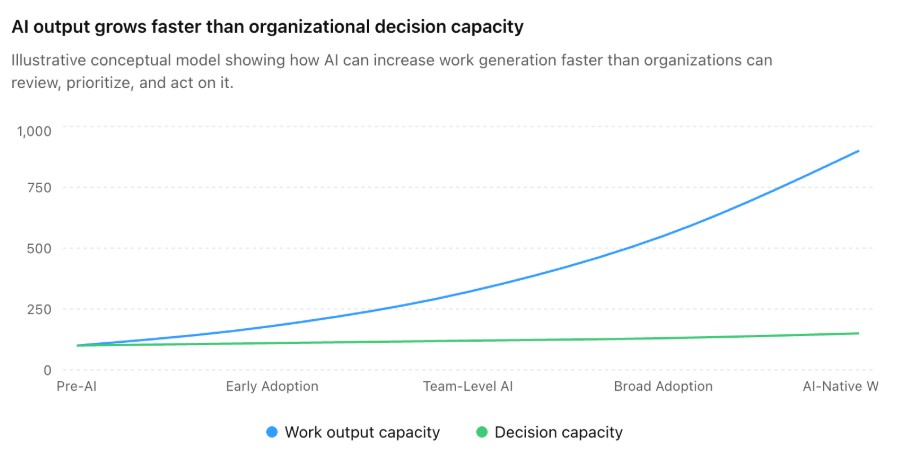
For years, organizational productivity was constrained by the cost of creating work.
AI changes that equation completely.
Today, teams can generate more content, more analysis, more outreach, and more strategic options than ever before.
The bottleneck is no longer producing work. It’s processing it.
And that’s creating a growing problem inside many organizations.
In conversations with HR leaders, I keep hearing the same story: some teams are racing ahead with AI while others are moving much more slowly. Before long, work starts stacking up at approvals, cross-functional projects slow down, and decision-making struggles to keep up with the sheer volume of new output.
What makes AI different from many previous workplace technologies is that uneven adoption doesn’t just create uneven benefits. It can create organizational strain.
With earlier technologies, one team adopting a better tool mostly improved outcomes for that team. If Marketing adopted better analytics software, or Finance automated reporting, those teams simply became more efficient. The rest of the organization could continue operating normally.
AI behaves differently because it changes the speed and volume of work itself.
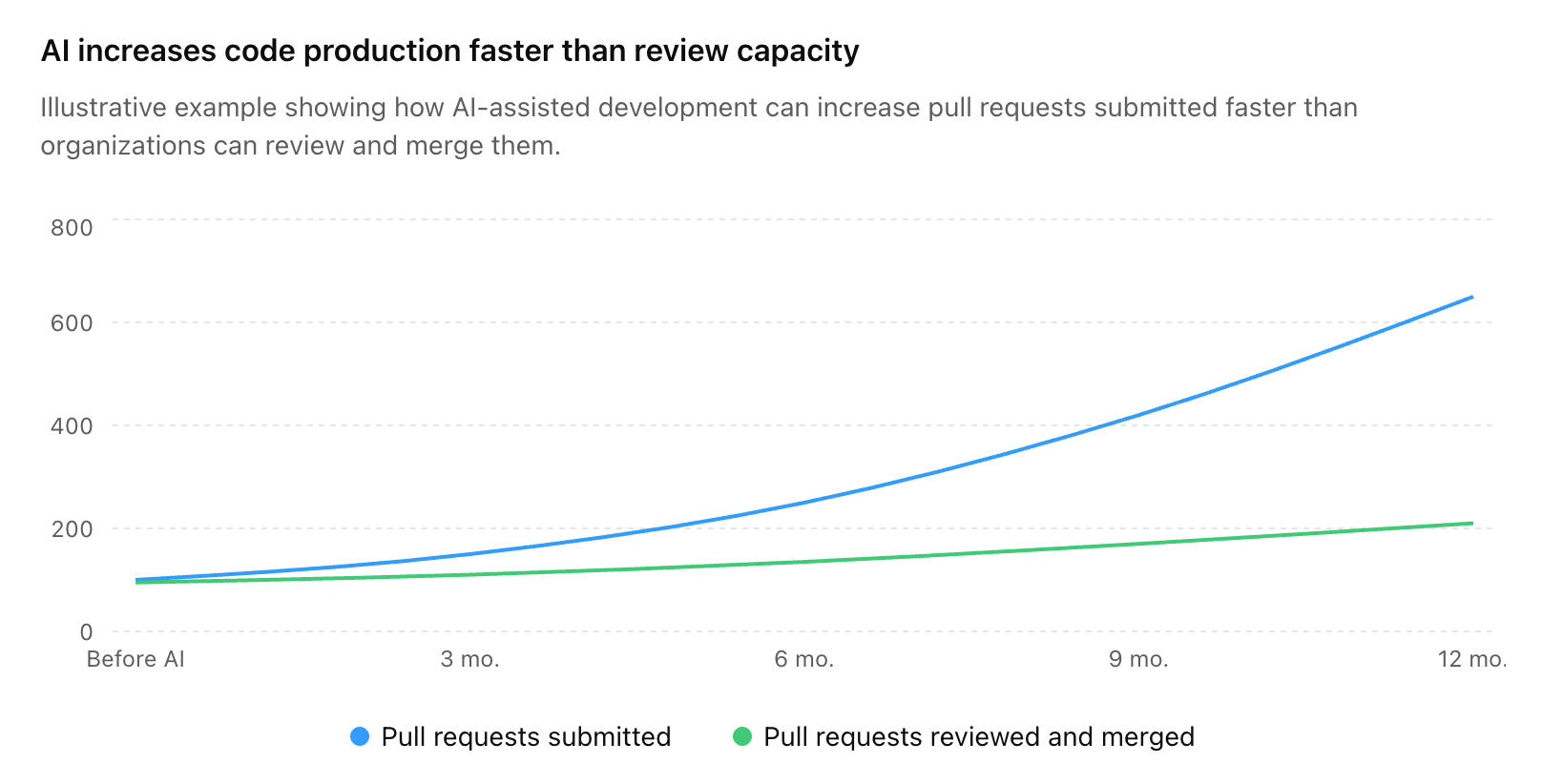
When one team suddenly produces twice as much output, every connected workflow feels the pressure. Approvals, reviews, downstream teams, and decision-makers all become part of the bottleneck. The faster team doesn’t just move faster independently. It changes the operating tempo of the system around it.
The assumption was that AI would make organizations move faster.
In many cases, it’s revealing why they couldn’t move fast in the first place.
Inside many companies, adoption is happening unevenly.
Some teams have embraced AI aggressively. They’re automating repetitive tasks, accelerating research, generating content instantly, and compressing workflows that used to take days into hours.
Other teams are moving much more slowly. Some are cautious about quality risks. Others are still figuring out governance, tooling, or training. In many cases, adoption depends entirely on individual managers or employees.
This creates a new kind of operational mismatch.
One team begins operating at what you could call “AI speed.” They move faster, iterate faster, and generate significantly more output.
But the teams around them may still be operating with traditional workflows, manual reviews, and slower decision cycles.
And when those teams interact, the friction becomes visible almost immediately.
Fast teams collide with slow systems.
Work stalls during handoffs. Reviews pile up. Approval queues grow longer. Dependencies become bottlenecks. Delays compound across the organization.
From the perspective of employees, it feels like the organization itself is breaking down. But what’s actually happening is more subtle: individual parts of the system feel like they’re humming along normally, while the organization itself has become increasingly out of sync.
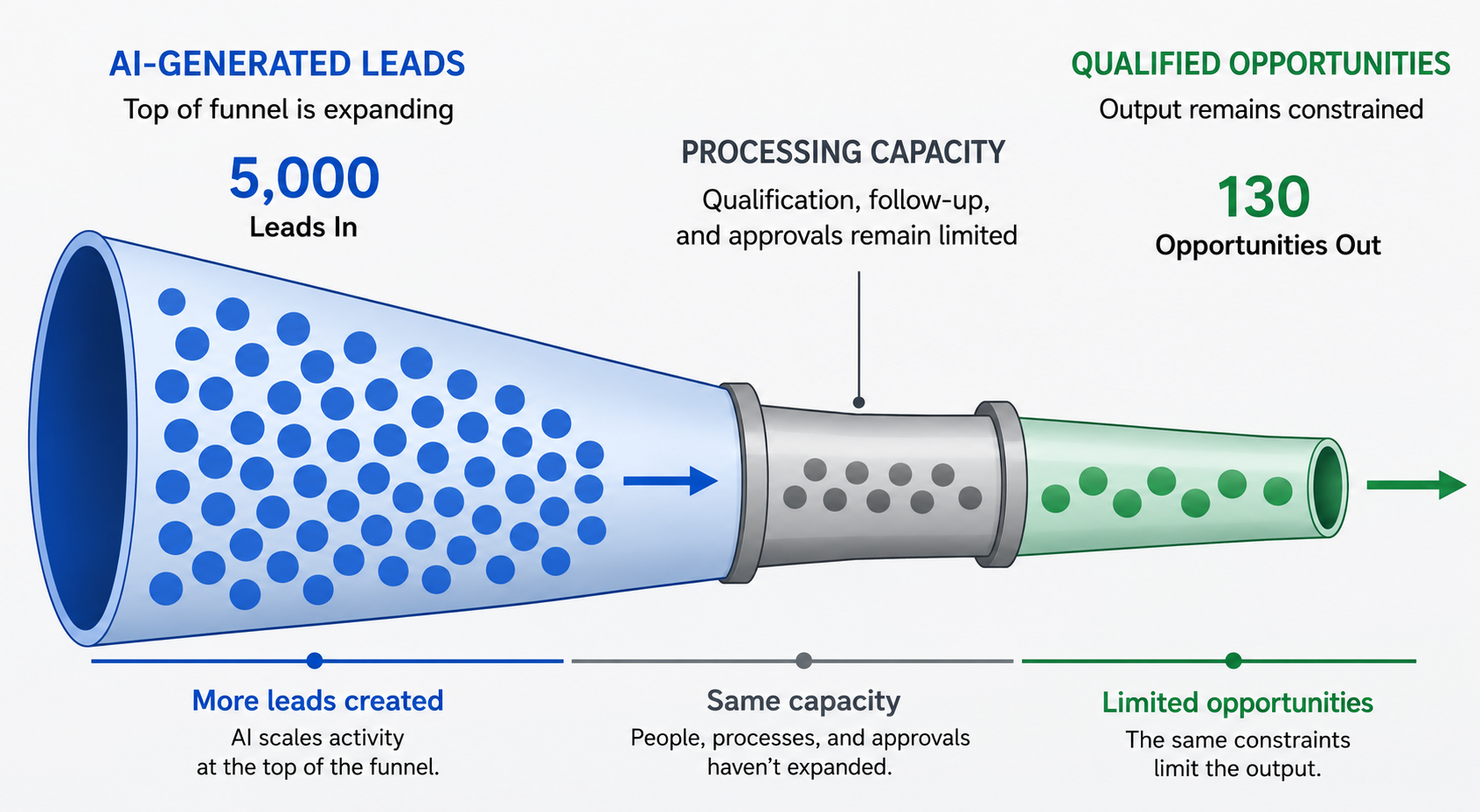
You can already see this dynamic emerging across Sales and Marketing teams.
Sales organizations, particularly SDR and outbound teams, have been among the fastest adopters of generative AI. Reps can now research prospects, personalize outreach, draft emails, and scale prospecting activity dramatically faster than before.
On paper, this looks like a major productivity breakthrough.
But in many organizations, Marketing hasn’t accelerated at the same pace.
Campaign development, content approvals, lead qualification processes, and funnel management often remain constrained by traditional workflows and stakeholder reviews.
The result?
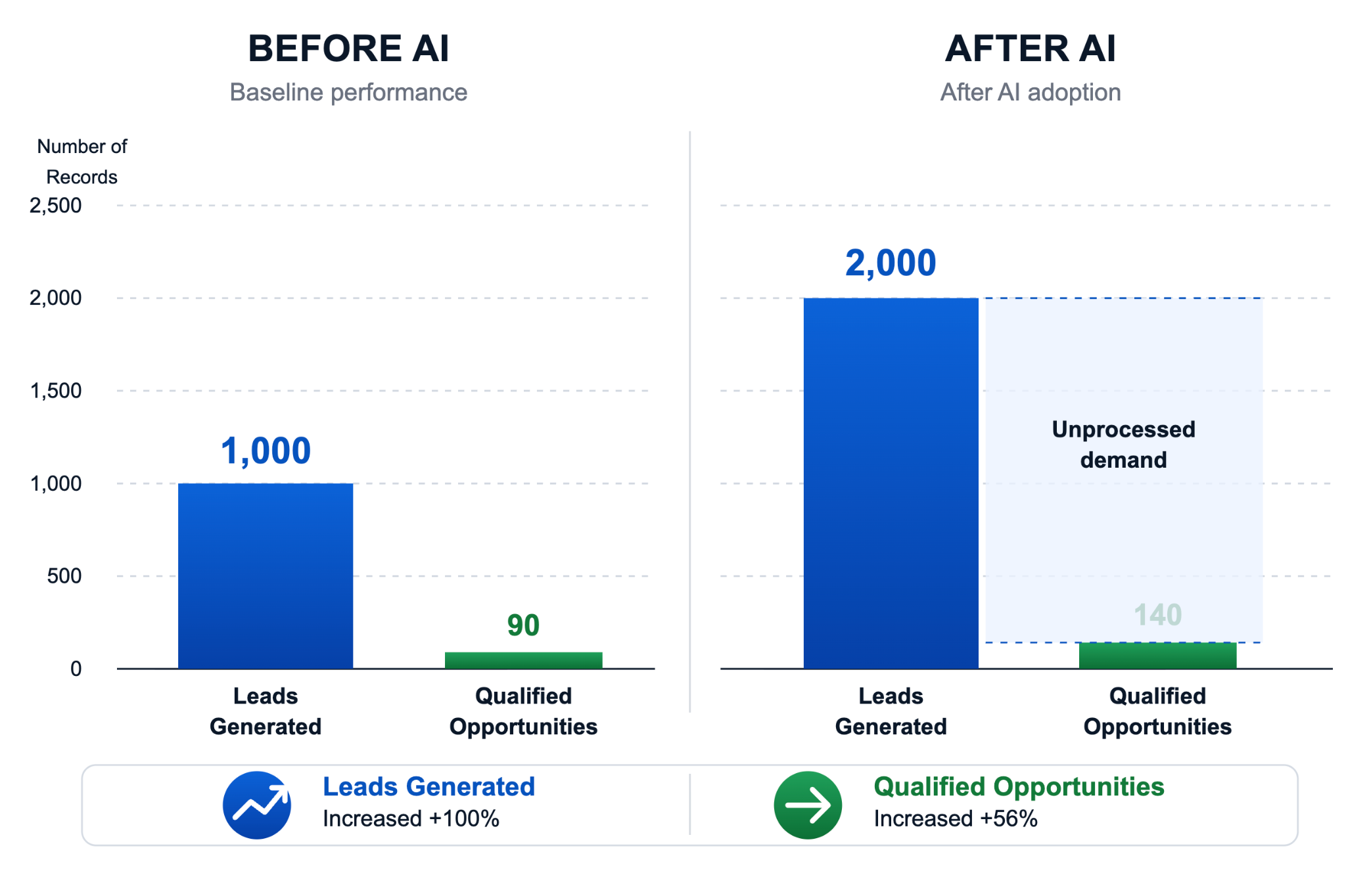
More leads enter the CRM, but they don’t move through the funnel any faster.
In some cases, funnel velocity actually slows down because downstream systems become overloaded. Teams generate more activity without increasing the organization’s capacity to absorb it.
The front end sped up. The rest of the system didn’t.
AI introduces a critical organizational challenge: gains in one area often create bottlenecks elsewhere. As one part of the business accelerates, connected workflows come under pressure.
There’s another layer to this problem that organizations are only beginning to understand.
AI dramatically lowers the cost of producing work. But it does not lower the cost of deciding.
And decision-making is increasingly becoming the real bottleneck.
AI makes it easy to generate more of everything. More presentations, more analyses, more product ideas, more content drafts.
But volume alone doesn’t create business value.
At some point, someone still has to determine what matters, what gets prioritized, what moves forward, and what gets ignored.
That sounds manageable in theory. In practice, it creates enormous strain, especially inside large, consensus-driven organizations.
These companies already tend to move more slowly because decision-making is distributed across many stakeholders. Alignment takes time. Reviews take time. Prioritization takes time.
Now AI enters the system and multiplies the number of possible decisions.
The number of choices expands faster than the organization’s ability to evaluate them.
Unlike content generation, decision-making doesn’t scale efficiently. In many cases, it becomes harder as volume increases.
More options create more ambiguity.
More drafts create more review cycles.
More ideas create more prioritization conflict.
So while output rises dramatically, organizational outcomes often fail to improve at the same pace.
Because the true constraint is no longer producing work.
It’s processing it.
A useful way to think about this is organizational whack-a-mole.
Imagine a technology company where engineering teams are struggling to ship products because product managers can't write specifications fast enough. The company improves that process. AI helps generate requirements, documentation becomes easier to create, and engineering throughput increases.
But then a new bottleneck appears.
The product team is now waiting on design. So the company speeds up design reviews and accelerates the creation of mockups and user flows.
Then another bottleneck emerges.
Products are ready to launch, but legal and compliance teams can't keep pace with the increased release velocity. What was once an engineering problem has become a legal capacity problem.
This is how constraints move through organizations.
Removing one bottleneck rarely solves the entire system. It simply exposes the next limiting factor. As AI accelerates work across functions, organizations will need to continuously identify where new constraints are forming and address them through better processes, clearer decision-making, improved workflows, and targeted use of technology.
The speed of the organization is ultimately determined by its slowest link. AI can make individual links dramatically faster, but realizing the full value requires improving the entire chain.
Most conversations about AI and productivity focus on individual efficiency.
But the companies that benefit most from AI likely won’t be the ones that simply create more work faster.
They’ll be the ones that redesign their systems to absorb speed effectively.
That means rethinking:
In other words, AI doesn’t just challenge how employees work.
It challenges how organizations operate.
And many companies are about to discover that the hardest part of AI adoption isn’t generating more output.
It’s building organizations capable of handling it.