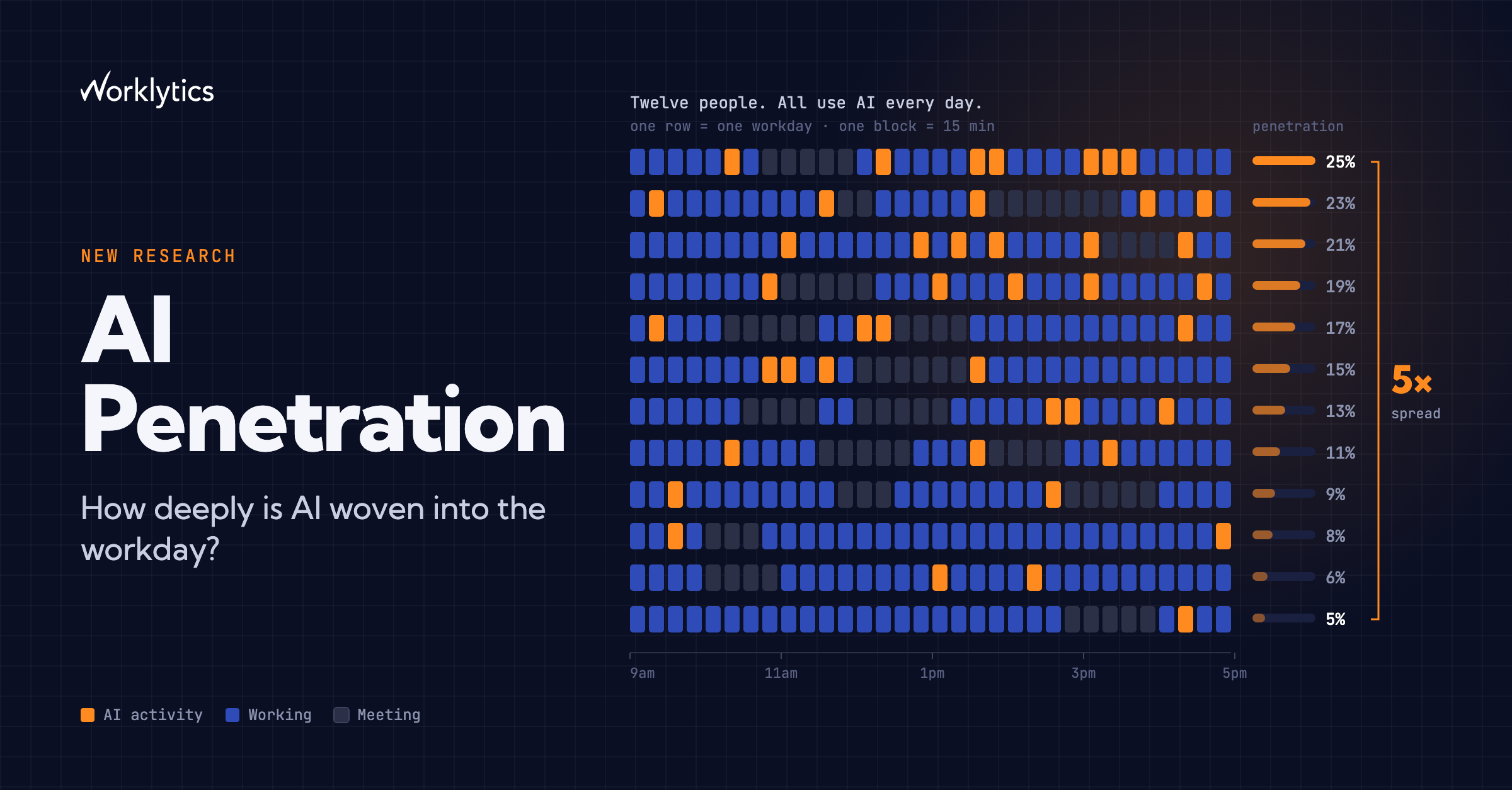
Days used and total uses can't tell your AI users apart anymore. AI Penetration measures how much of each person's available working time AI actually reaches.
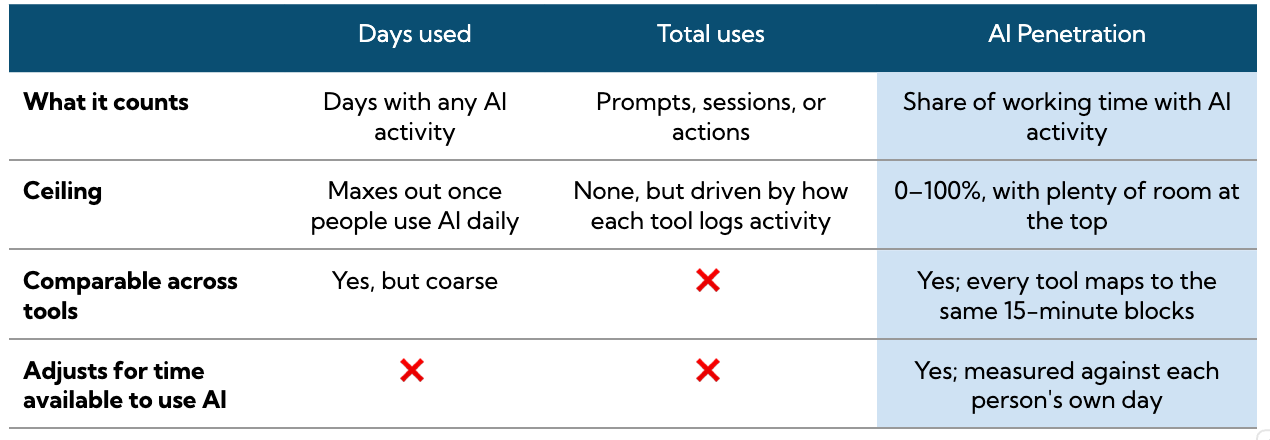
Most AI adoption reporting relies on two metrics: the number of days a person uses AI, and the total number of times they use it. Both were well suited to the early stage of adoption, when the central question was whether employees were using AI at all. That question has largely been answered, and neither metric holds up well against the question that follows.
‘Days AI Used’ has a ceiling. It can go no higher than the number of working days in the period. As more of the workforce uses AI daily, employees cluster at the maximum and the metric stops distinguishing between them. Someone who asks a single question at 9am receives the same value as someone who works alongside AI throughout the day.
‘Total AI Uses’ has no ceiling, but is inconsistent across tools. What counts as a "use" varies from one tool to the next: a single agentic coding request can accomplish what once took dozens of autocomplete acceptances. The count also rises with the length of the workday, regardless of whether AI played a larger role. Ultimately, it reflects how much activity a tool logged, not how much of a person's work AI reached.
Neither metric answers the question leaders are now asking: where has AI become part of how work gets done, and where are licenses going unused?
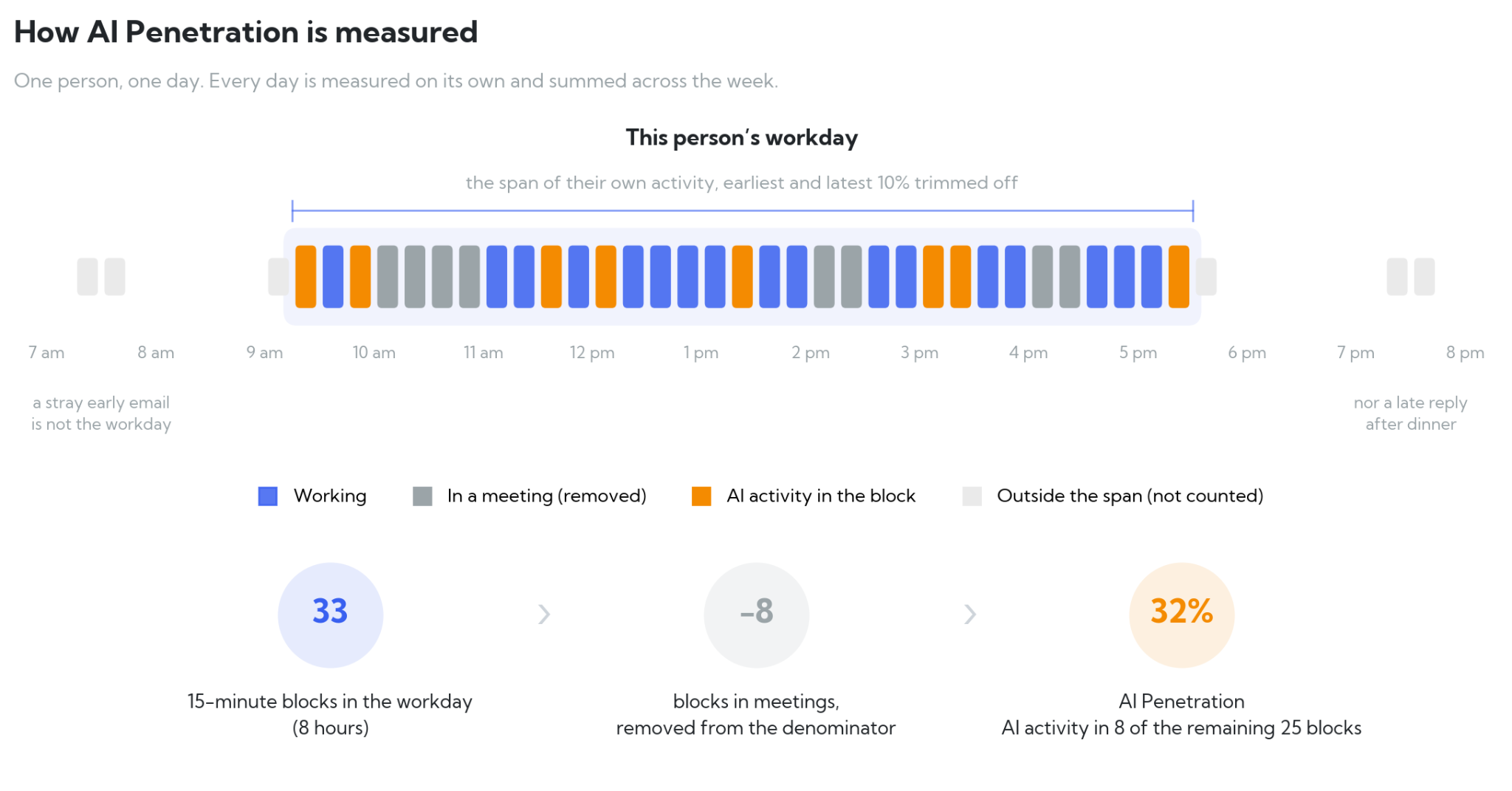
AI Penetration is the share of a person's available working time that involves AI. Rather than asking whether someone used AI on a given day, it measures how integrated AI is in the time they have to do their work.
Because penetration is a share of time, it depends on an accurate measure of the workday. Using our proprietary data, we are able to estimate each person's workday based on their actual digital activity instead of having to assume a standard 9-to-5.
We begin with the span between a person's first and last meaningful activity of the day, divided into 15-minute blocks (we systemically trim isolated outlier activities early in the day or late at night). Each day is estimated independently, so a shorter Friday is treated as a shorter day. We then remove meeting time. What remains is a person’s available working time, and penetration is the share of it that contains AI activity.
For example (illustrative): someone works from 8:30 to 6:00, which is 38 15-minute blocks. Three hours of meetings take out 12 blocks, leaving 26. AI activity shows up in 6 of those 26 blocks, so their penetration that day is 23%.
Two design choices matter:
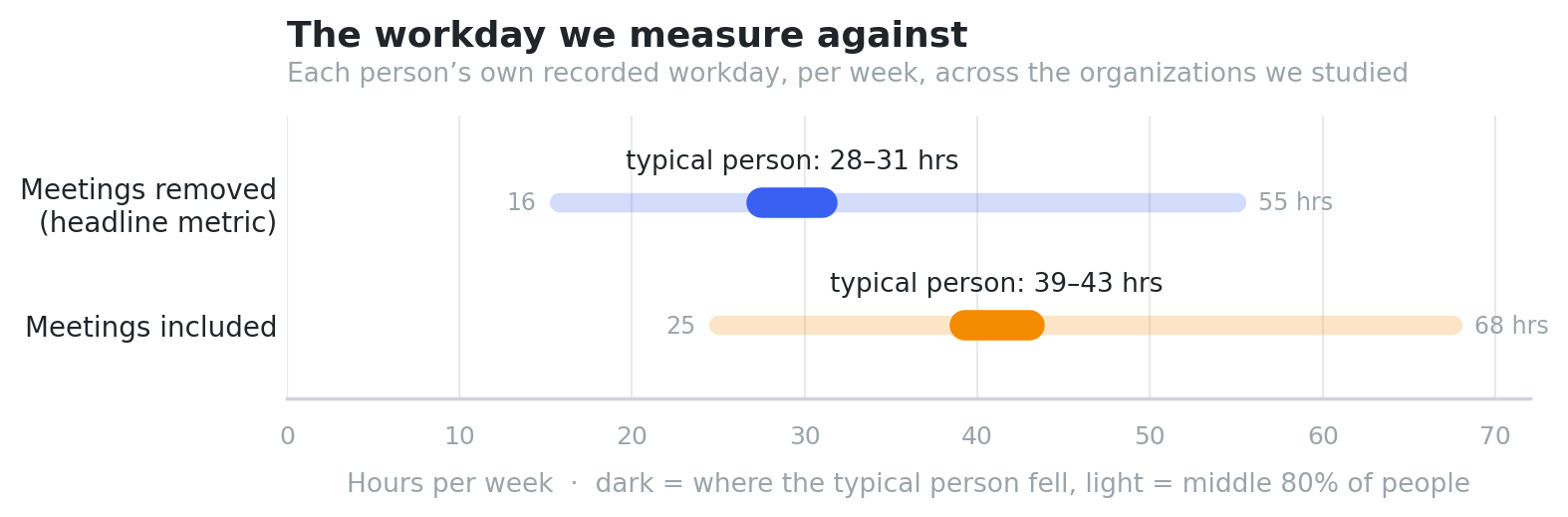
We performed a wide variety of tests to ensure our workday measurements fairly represented the typical workday, while also leaving room for variance on a day-by-day basis. Across the organizations we studied, the typical person's weekly span landed between 28 and 31 hours with meetings removed and 39 and 43 hours with meetings included.
Consider every employee who uses AI daily. A typical adoption dashboard would classify them as your most engaged users and score them identically. Measure how much of their available working time AI actually reaches, however, and a different picture emerges. Some use AI 5% of their available working time. Others exceed 25%.
That fivefold gap exists within a group the old metrics treat as uniform, and it is wider than the gap between weekly and daily users. The variation is also stable: individuals hold their level from week to week, and the pattern appeared in every organization we examined.
Among people who use AI every day, actual AI penetration can vary drastically.
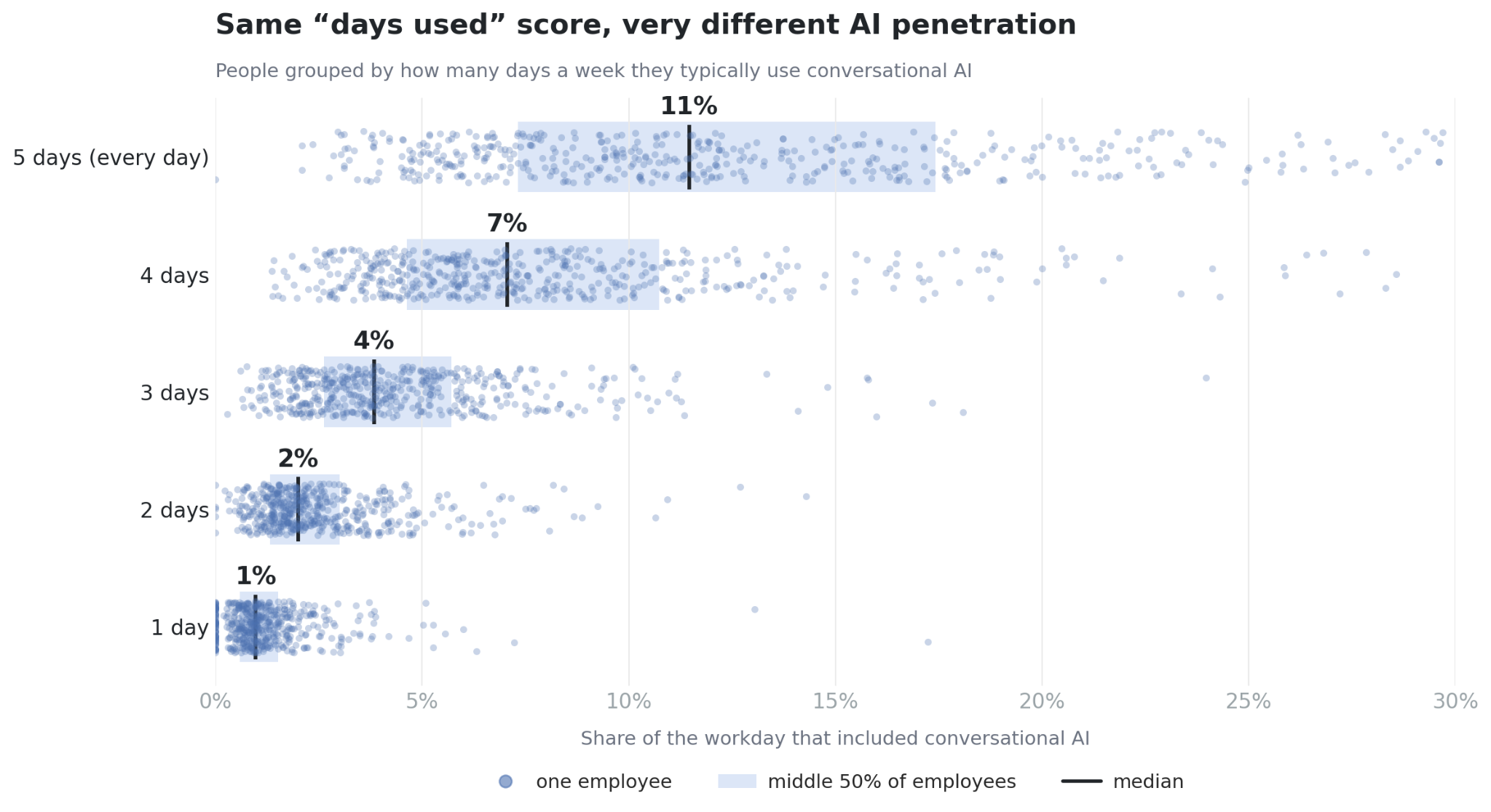
AI users across the organizations we studied. One dot per person; dots are a sample of 500 per row, while the median and shaded band use everyone.
One of the first relationships we explored with the new metric was between AI use and time spent in meetings, working with the organizations that connected their AI tools first.
Among people with AI deeply integrated into their work, meeting time is lower. The further AI reached into someone’s available working time, the fewer hours they spent in meetings. The relationship is gradual: meeting time declines steadily as penetration rises. We generally see this pattern hold for managers and individual contributors, and for engineers and non-engineers alike.
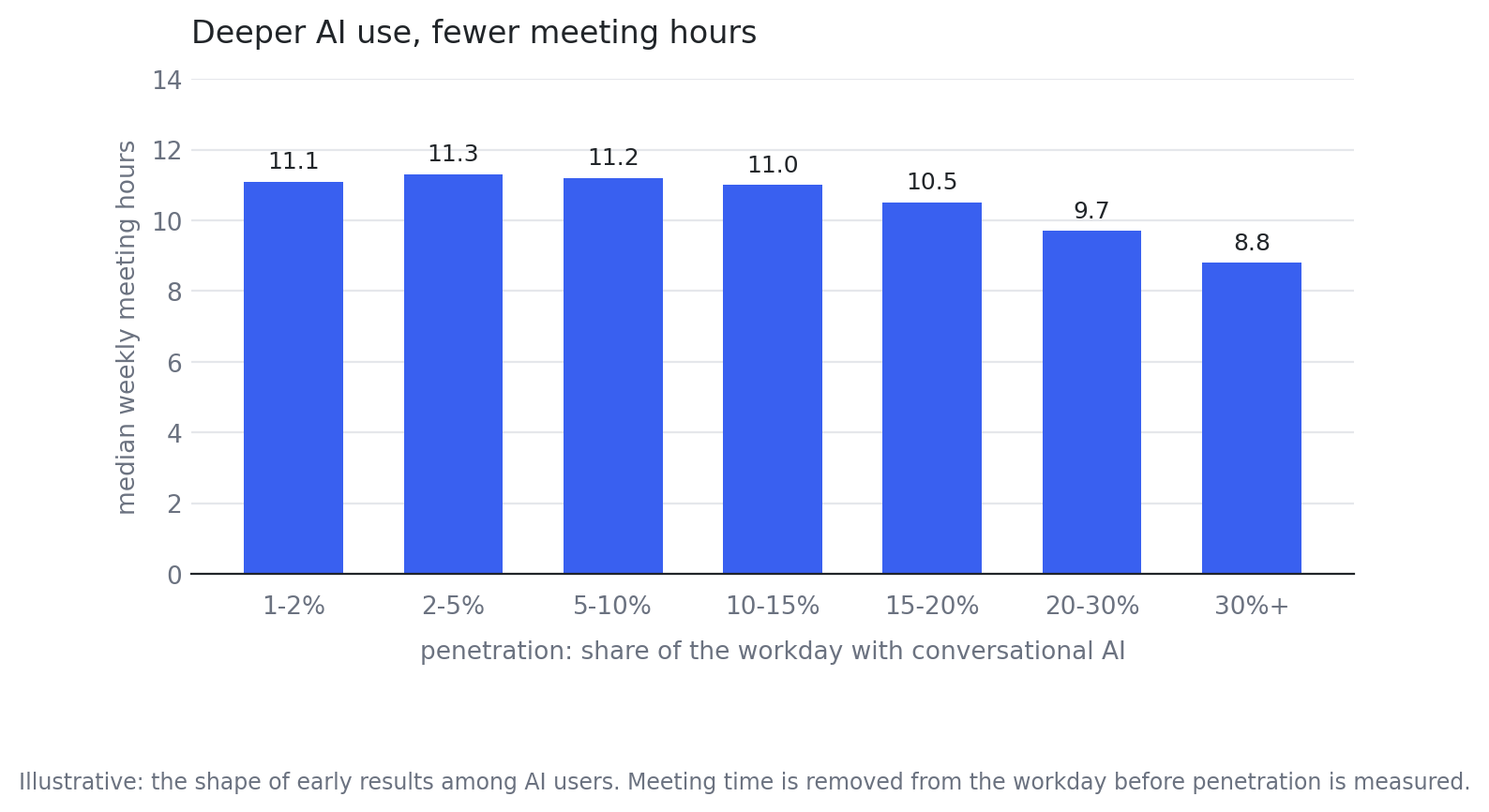
Weekly meeting hours by AI Penetration level
It would be tempting to conclude that cutting meetings will lead to deeper AI penetration, but the data suggests it isn’t that simple. Among people already using AI, those whose meeting load dropped during our study period did not go on to use AI more than those whose calendars held steady. Deeper AI penetration doesn’t shrink the calendar either. So lighter calendars and deep AI use go together, but the relationship depends on timing.
The difference was there before AI arrived. The people who use AI most deeply today spent about an hour less per week in meetings before they ever used it, and the gap persists after controlling for role, function, and tenure. When AI tools arrived, these employees had the space to experiment, build skill, and integrate AI into their day-to-day work, an opportunity rarely available to someone moving from one meeting to the next.
That space matters most at the start. Once someone is already using AI, a lighter calendar no longer predicts whether they go deeper. The most practical way to deepen AI adoption may be to protect time during the first weeks of a rollout, while the habit is still forming.
These are just a few early patterns we see in our work with various organizations. But they illustrate the kind of questions penetration was designed to answer.
Our suite of AI Penetration metrics is now live for every event-level AI tool you have connected with Worklytics. The more of your AI stack you connect, the fuller the picture becomes: the day AI arrived, who leaned in, and how it has reshaped the workday since. Adoption was last year's question. This is the one that comes next.
Not sure which of your tools are connected? Ask your Worklytics contact.