Companies are hoarding AI tools like my 3rd grader collects Pokemon cards.
Every team is buying. Every vendor is shipping. Every workflow is getting “AI-ified.”
But the hard truth?
By 2026, half of these tools will disappear.
Not because AI is slowing down – it’s not.
But just like my son eventually realizes half his Pokémon cards don’t actually do anything…companies are about to realize half their AI tools don’t either.
AI only works when it’s embedded, not when it’s bolted on.
Let me explain.
People often assume AI usage comes down to which tool is “better.”
But that’s not the full story when it comes to adoption in organizations.
As competition intensifies, quality gaps between leading enterprise models shrink, so model quality matters less over time.
What matters now is whether that tool shows up inside the workflow that people are already living in.
Take the most obvious example:
ChatGPT is a powerhouse.
But it’s standalone. You have to consciously pull up a tab to go to it.
Google Gemini and Microsoft Copilot, on the other hand, sit inside a bunch of workflows.
You don't have to remember to use them — they’re just there when you open an email in GMail or pull up a spreadsheet in Excel. Auto-completing. Suggesting. Summarizing.
Which tools are frictionless enough to become a habit?
Which are positioned to reshape how teams work day to day?
Exactly.
Copilot may not be the “smarter” LLM model. But it’s the one that’s already there when you pull up a Word doc. So it’s ultimately positioned to drive more adoption..
We see this pattern repeating across functions.
Think about Salesforce.
Every sales org wants better forecasting, cleaner CRM data, and more consistent follow-ups. There are dozens of AI tools claiming to solve these problems.
But the ones that actually stick?
The ones inside Salesforce.
Not the “open a new tab, connect an API key, export/import data” type.
Because if a rep has to leave their workflow, adoption tanks instantly.
They forget. Don’t have time for the extra clicks. Or it just doesn’t fit how they work.
It’s the same with engineering, marketing, support... The AI that wins is the one that accelerates the workflow, not the one that interrupts it.
So how many AI tools do we need to have?
Today, AI tooling feels a bit like SaaS did in 2013–2017. Explosive, chaotic, exciting, and… unsustainable.
Everyone is buying tools.
Everyone is experimenting.
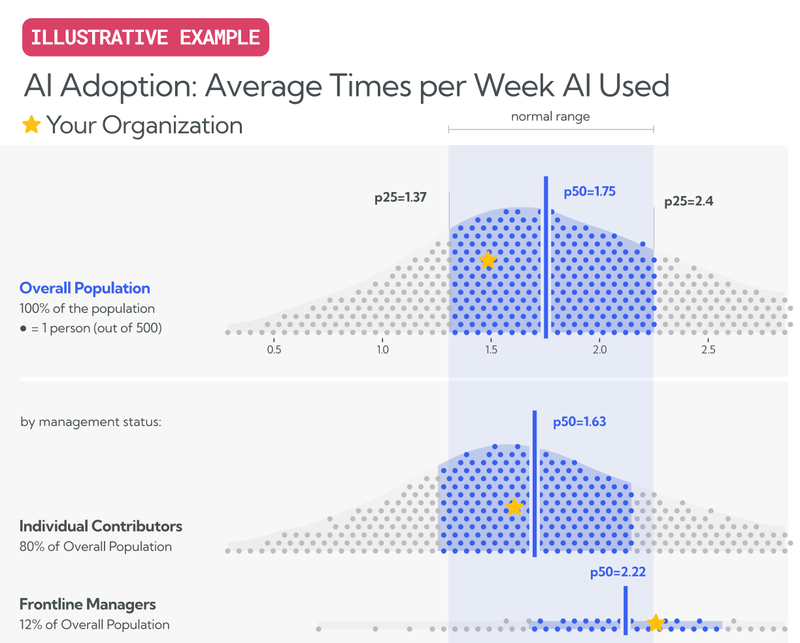
And almost no one is measuring usage in a meaningful way.
Most companies don’t know:
But CFOs are paying attention.
AI may sit across many different budget-holders and span multiple line items, but your finance team sees that the costs are mounting.
“We spent $X on AI tools in 2025. What did we get from that investment?”
The moment companies start pulling usage data — and they will — the culling begins.
Expect:
There are simply too many tools, and most aren’t delivering enough value to justify their price.
By 2026, I’d bet the average mid-sized company reduces its AI tool count by 30–50%.
Not because AI is slowing down.
But because real adoption creates clarity. And clarity will drive consolidation.
Want to get ahead of that shift?
To prepare for AI consolidation, here’s what I’d do today:
Start with:
“Where do people spend their time?”
Then ask:
“How can we integrate AI into that?”
Because that’s where you’ll see ROI.
If your CRM, code editor, or document suite offers built-in AI — start there.
Let the workflow do the heavy lifting.
Employees often report that they “use” a tool more than they actually do.
Usage analytics reveal the truth.
Some niche AI tools are worth keeping — but only if they provide value no general AI can replace.
Don’t wait for the CFO’s email in Q1 or Q2 next year.
Build your list of high-value, medium-value, and low-value tools early.
The winning companies won’t be the ones with the biggest AI stack.
They’ll be the ones that figure out:
This isn’t about being “AI-forward.”
It’s about being workflow-forward, with AI woven in.
And that’s why tool count isn’t the metric to watch.
Usage is.
Integration is.
Business impact is.
Everything else is just noise — and that noise is about to get a lot quieter.